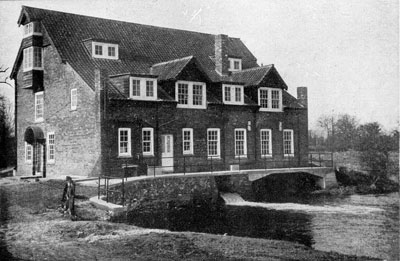
c.1909
Itteringham Mill River Bure |
|
c.1909 |
N.B. The village of Itteringham has its own website www.itteringham.com |
There has been a watermill in Itteringham since before the Domesday survey in the 11th Century and two mills were also recorded in the now amalgamated parish of Mannington. Ironically many mills tended to burn down approximately every 200 years (mainly due to friction and large amounts of flour dust) and the present main structure was built in 1783. During renovation work in 1938, the builders discovered the inscription R.W. 1783 scratched in the plaster at the back of the water wheel and this was left intact.It was found again in April 2009 during the extensive alterations of that year. |
Itteringham mill was built of Norfolk red brick and had a Norfolk pantiled roof. The three distinctive two storey dormers and the lucum were all of white weatherboard. The millstones used during the latter years of production were all French burrstones, which meant that the mill was grinding wheat for flour. A small lockable drawer underneath a narrow window in one of the downstairs rooms of the mill cottage was still in situ in the 1970s and was probably originally used for taking payment and was once part of the original exterior wall. Itteringham watermill is the fourth mill down from the source of the Bure. |
Herold was lord of the second manor at the first survey, but William Earl Warren at the Conqueror's, a freeman held of Herold 15 acres, there were 3 bordarers, one carucate and one acre of meadow, paunage for 4 swine, the right in half a mill, and was valued at 3s. In the reign of Henry II. the Earl Warren enfeoffed the ancestor of the family of Wolterton in this, who had a third part or portion in the advowson of the church, and this part passed (as may be seen in Wolterton ) together with their manor there, through many hands, to James Grey, Esq. and from his sisters to the Honourable Horace Walpole , Esq. |
The master of the hospital of St. Thomas the Martyr at Beck-hall, in Billingford, owned the water- mill here in 1284, and Hugh Tirell of this town granted small rents out of lands here to Giles's hospital Norwich. |
 |
Estate map 1722 before the bypass to the north was cut |
 |
 |
October 1972 |
4th September 2004 |
| As with many watermills, the ancient course of the river was altered in order to provide a better head of water for the mill. This probably took place in the 1700s and involved the digging of a wide new cut some 250 yards long with a high bank on the northern side where the river was to be several feet higher than the surrounding terrain. A bypass was also cut in to go around the north side of the mill in order to control the water in times of flood. Once the cut had been finished the old course would have been dammed allowing the river to back up and deepen to form a reservoir - the mill dam. It is probable that this work was undertaken during the tenure of William Colls. |
Colls Family
The Colls family were Quakers and their Pedigree is entitled: Colls of Burgh by Aylsham, Horstead & North Walsham. |
Henry Colls of North Elmham married Elizabeth ? in 1628. When Henry died in 1641, his wife Elizabeth was the sole executor. |
On 10th December 1783, William Colls leased the mill from the Hon. Horatio Walpole for 50 years at a rent of £40.00 per annum
- new mill lately erected and built by William Colls on the site of the old mill that was lately standing on the premises. William Colls had already rebuilt the mill to power two pairs of stones. One pair were German Cullins for milling wheat to flour and the other pair consisted of a Derby Peak runnerstone over a French burr bedstone for milling rye. French burrstones were expensive and were almost exclusively used for flour milling, thus the above arrangement might have come about if the mill had been converted to rye milling by buying a cheap peak runnerstone. By 1831 an inventory showed that the wheel was now powering three pairs of stones via a 9 foot diameter spur wheel with a 7 foot diameter crown wheel set above it. |
Between 21st June and 11th August 1838, the Mill machinery was renovated by millwright James Winterborn of Aylsham for the Earl of Orford. The total cost was £50 11s 7½d. Various individuals from the village also took part in the renovation work including Nathaniel Brett, carpenter and wheelwright; Henry Hall, blacksmith, Edward and Samuel Slipper who worked with Henry Hall to remove some of the old machinery and Thomas Ward, bricklayer, who worked on the watercourses under the mill as well as repairing the various buildings. |
|
60 Years in the Long Life of Itteringham Mill |
|
|
Probably since Domesday, if not earlier, Itteringham has had a large water mill at its present location near the bridge on the main road through the village. We know that in 1742 Robert Colls was renting the mill from Mannington estate and also held with it a small farm of 17 acres in 9 different pieces or fields. Fortunately a deed and associated working papers (WAL 367) has survived in the Walpole papers held in The Norfolk Archive Centre in Norwich which tells us quite a bit about the nature of the mill between 1783, at the start of a new lease, and 1838-39 when it was extensively repaired. This article summarises the facts but, being written by a non-expert, makes no attempt at interpreting precisely what sort of mill it was and its capability and efficiency relative to others of its time. The 1783 Lease |
|
|
|
William’s father Robert had died in September 1777 and subsequent to taking over the family milling business William had taken the big decision to do a complete rebuild of the mill. Did he increase its capacity or had it for a long time been a large mill with two pairs of stones, one for wheat and one for rye? |
|
|
|
As we shall see, this clause is later invoked. The 1831 Inventory In turn by early 1800 Thomas Roberts had taken over as miller and remained there at least until the end of 1811 when the poor rates book ends. He was still in the village and presumably the mill in 1825, since in October of that year he was a witness at his daughter’s wedding in the parish church. He died aged 68 in March 1830 and was buried in Itteringham churchyard. At the moment we do not know precisely the occupancy sequence from then until the late 1830s. But we do know that an inventory of the mill mechanism was done in 1831, presumably at the time of a change of tenant. The inventory gives a good description of what has now become a water mill driving three pairs of stones: |
|
|
|
From the 1838 documents it looks likely that this inventory was done for the use of the mill by John Gambling, but we cannot be sure since there are no names mentioned on the inventory.
The 1838 Repairs As an introduction to the work described and bills submitted, we have an agreement drawn up between William Lemmon, Lord Walpole now the Earl of Orford’s steward or agent at Wolterton, and John Cook Beane now the miller. This commits to some contributions to costs by Orford which apparently supersedes the old lease obligation on the tenant to do repairs. By the absence of any other lease deed in these papers it seems likely that the 1783 lease deed, although more than four years over its term, was still effectively the basis for tenancy and rental arrangements. A commitment is also made to begin a new lease. |
|
|
|
White’s 1845 Norfolk Directory tells us that in Buxton there was a corn millers and merchants called Cooke and Gambling (John). So John Cook Beane and John Gambling were in business together and W Lemmon could readily assume that in signing the agreement Beane would deliver Gambling’s written disclaimer to the machinery. There then follow a dozen or more bills, receipts and scraps of paper with calculations on the division of costs between landlord and tenant. These tell us what was done in the repairs by millwright, carpenter, blacksmith and bricklayer. James Winterborn the Millwright Winterborn of Aylsham submitted a bill in two parts for £50 11/7½d for the period 21 June to 11 August 1838 and for £8 19/4½d in September 1838. The major items include: |
|
|
|
Nathaniel Brett the Carpenter/Wheelwright Timber bills, over and above the sum charged by Winterborn, amounted to well over £10 in total; but not all purchases are itemised, with anonymous cash sums making up quite a large part of the total. At least some of the timber was bought from Isaac Preston and Son of Yarmouth. Henry Hall the Blacksmith He also worked with Edward and Samuel Slipper from the village in 1839 to take down part of the ‘masheen in the mill’. Thomas Ward the Bricklayer |
|
|
|
He charged himself and his labourer out at the less substantial sum of 3/4d per day for the two of them. *** A handful of scraps of paper show various attempts to total the cost of work and to allocate costs between landlord and tenant. No single one of them appears to show a definitive total, but one shows a total of £124 ‘paid by Mr Beane’ and another allocates Mr Cook Beane £91. The total probably came to around £124 to £150. A nice footnote brings us back to ‘dilapidations’ of the grinding stones. A copy of a note from W Lemmon, presumably to John Cook Beane, of October 1839 says that he is sending him ‘the copy of the lease of Itteringham Mill in which you will see Lord Orford’s claim for the mill stones’. It goes on to claim £16 for the full 9 inches of wear on the pair of stones called Cullens, 7 inches of wear on the Peak and 3½ inches on the French stone. |
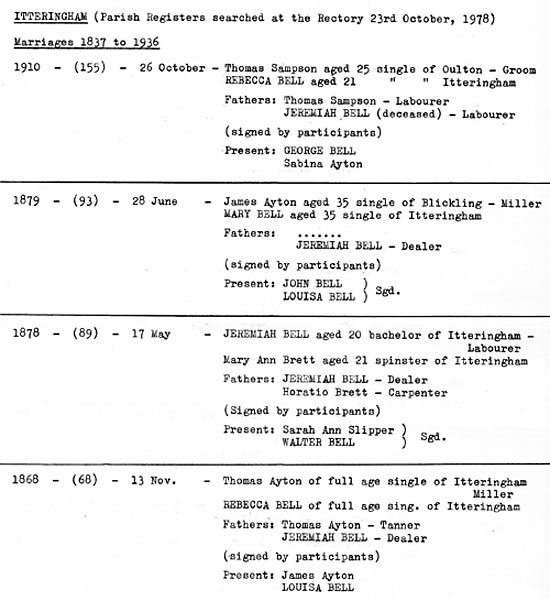 |
Ayton & Bell marriages |
Mathew Arthur Slipper was known to be the illegitimate son of Charlott Tipple and the 4th Earl of Orford (1813-1994). He was born 18 June 1839 at Itteringham and was apprenticed as a miller at the mill before moving to work at Upper_Sheringham_postmill where he was listed as journeyman miller in the 1841 census. Later still he became the publican of the Lobster Inn at Sheringham. In 1861, he married Susan Cooper, who was born on 22nd December 1843 in Sheringham and they went on to have 10 children. Mathew Arthur Slipper died on 4th November 1919. |
Matthew Slipper was the illigitimate son of the 4th Earl of Orford. His mother Charlotte was a seamstress at Mannington Hall. She later married a Tipple and produced another child by him. I have a detailed family history which tells me that Matthew was still at the Lobster Inn, Sheringham, in 1902. He married Susan Cooper of Upper Sheringham. They had 10 children 8 of which survived. There are 2 graves in the churchyard at Upper Sheringham. He was much involved in the local leadership, now council. He handled the Poor Law money in Lower Sheringham. One of his sons was the Village Constable, another had a sweet shop and a third, my grandfather, was a grocer and two daughters were teachers at the Upper Sheringham School. He died in 1919 Much of this information was gleaned from books written by Peter Cox, a local councillor and a family history produced by a relative. I have yet to discover why he was in Nottinghamshire when he died (perhaps one of his children lived there?) He is buried in West Bridgeford. |
The 1851 census showed that while the mill itself was being run by Frederick Copeman, the mill grounds were being run as a farm by William Hardmeat and his wife and they were living in the Mill House. William was aged 30 and had been born in Cromer and his wife Amelia, also aged 30 had been born in Metton. They were sharing part of the Mill House with one of Frederick Copeman's employees, Samuel Deane, aged 29 from Langmere, who was a journeyman miller. |
St. Ann's Iron Works, King Street, Norwich, 23 Apr. 1864. F. S. Watson, Esq, Sir, Having duly examined the Water Wheel and Shaft at Itteringham Mill I find it in a most delapidated condition and not in a fit state to be repaired. I therefore beg to lay before you an estimate. To take out the old Wheel and Shaft and fix in new ones. The wheel to be 16 feet diameter and 8 feet Wide, with three Cast Iron rings well fitted and bolted together, with Cast Iron Starts, Best Memel timber floats and back boards and all necessary bolts and nuts. One new Cast Iron Shaft to weigh about 35cwt., with neck carriages and wall plate with turned journals and Key and planed for hanging Wheel on Shaft, also two Gun Metal Neck Brasses, Cast and bored to fit the Same. Two Cast Iron Bosses and four Angles for hanging pit wheel on New Shaft, the above work, which shall be made of the best materials and sound workmanship for the sum of two hundred and seven pounds, ten shillings. I have the honor to be, Sir, Your Obt. Servt, Thos. Smithdale. £207.10. -. Oak starts, 190. 10. -. |
Frederick Copeman lived in the mill house, leasing Itteringham watermill from the Walpole Estate while owning Aylsham steam mill in Dunkirk. |
James_Brown, who was running the mill in 1864 was also a farmer and maltster. At one point in his career, he was probably also a tanner and lived at Tanyard Farm (later to become Bintry Farm). In 1828 he married Pleasance Copeman who was the daughter of Robert Copeman and sister of Frederick Copeman. One of James Brown's sons was Frank Brown, who by 1871, was running Roughton_Mill_Hill_towermill. |
|
It is a reasonable assumption that John Miller worked at the mill and he would have been an employee in 1869 |
The road brige over the river is around 200 yards upstream from the mill. The bridge used to be a rather picturesque single arch brick bridge but this was swept away in the flood of August 1912 |
 |
Road bridge painting c.1900 |
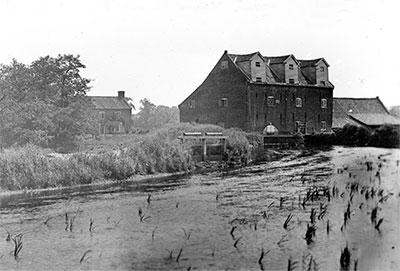 |
Mill working 1913 |
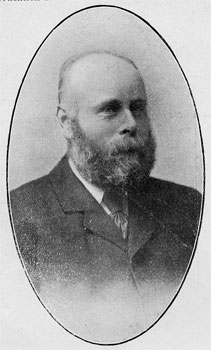 |
George Harvey Witham 1910 |
Walter Marcom was there in those days. We used to see him out walking and he had a big boot on one foot and the sole was several inches thick. Joan (Nellie) Hall née Wilch - 20th November 2007 |
My name is Alex Marcon, eldest son of Walter Hubert Marcon who was the Miller from 1918- 1934. |
Sidney Wilch was the landlord of the Walpole Arms at the top of the mill drive. My Dad also worked at and ran the mill and he had a fish round. He would call the horse from the orchard but he wouldn't come so he would yell "Edith!" Mother would come and she would call "Jack!" and he'd come trotting over and Dad would put the harness on him. He would drive to the train station at Aylsham to get the fish. Joan (Nellie) Hall née Wilch - 20th November 2007 |
Gladys Broughton who lived in the village often used to go down to the mill at the age of 14 in 1920 and recalled that the whole establishment was run as a farm as well as a mill. Chickens would often be lost as they had a habit of roosting on the wheel and didn't always get off before it was started up. Gladys Broughton |
Itteringham Mill finally stopped working in 1934 when Walter Marcon moved to North Barningham to take over a larger farm. In May 1936, owner Lord Walpole contemplated bringing it back into use but subsequently decided to convert it into a dwelling. Two alternative sets of plans were drawn up by the Cromer builder Girling & Smith and work started on the favoured version on 13th July 1938. The total cost of the whole project was approximately £2,500.00 and the project was overseen and recorded by Ernest Edward Smith himself, who was 71 in that year. Some of the photographs he took are on the separate Itteringham_Mill_Conversion page. Girling & Smith later also converted Antingham_Upper_Bone_Mill to residential use c.1946. |
 |
 |
View through the broken dormer pre-conversion in 1938 |
The stone floor - One of the grinding tuns on the 1st floor to the left The millpost and crown wheel rear centre The stone marked "A" was used as the front door step |
Transformation of a Norfolk Water Mill
|
Amongst the old watermills of Norfolk, the mill at Itteringham, near Aylsham, must at one time have ranked as one of the most important. A substantial structure of local red bricks, and housung an undershot wheel of the type common to the majority of Norfolk water mills, it was built across the river Bure just outside Itteringham village in 1788, and there is no doubt that in the ensuing years it did yeoman sevice to the surrounding farmers until finally the march of modern methods compelled it to close down for good in 1913. For the next 25 years the building seems to have served no useful purpose and simply stood neglected, the sport of wind and weather, until in 1938 it had reached the state of delapidation and decay shown in our first illustrations. At this stage, however, the present owner, Lord Walpole, on whose estate the building stands, decided that it deserved a better fate and in consultation with his builders a plan was finally arrived at for reconstructing it as a private residence whilst still retaining the main features of the original. The work was carried out during the latter half of 1938, and now the exterior elevations once again face the elements in as staunch and sound a trim as ever they did. But inside 'tis feared that the ghosts of the old millers would be hopelessly lost. Where once they stood and watched the golden grain trickle down to the rumbling stones, is now m'lady's boudoir with central heating and electric light, whilst the corn bins above have become light and airy bed rooms for staff or guest. And below, in the lounge, the walls which once housed the gurgling wheel now form the sides of an imposing brick fireplace with a section of the old main cog wheel worked into the mantle and one of the old mill stones taking pride of place in the centre of the hearth. The transformation, both inside and out, may well be judged by the accompanying illustrations. Thus do we endeavour to capture some small measure of the spirit of the past, and pass it on to future generations, hoping that the result of our labours will stand the test of time as well as did the work of our ancestors. Ernest Geoffrey Smith - c.1939 |
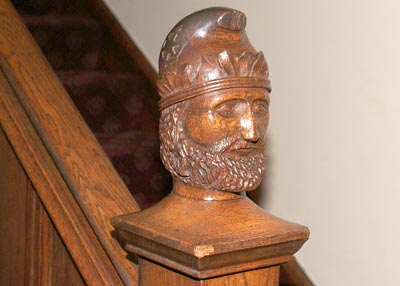 |
The Saracen's Head 31st October 2004 |
At the foot of the main staircase is a carving of the Saracen's Head. It was carved by Ernest Geoffrey Smith of the Smith family building firm, Girling & Smith Ltd. of Cromer, who converted the mill to residential use in 1938. The only local connection appears to be that of the Saracen's Head pub on Lord Walpole's nearby Wolterton Estate that originally owned the mill. |
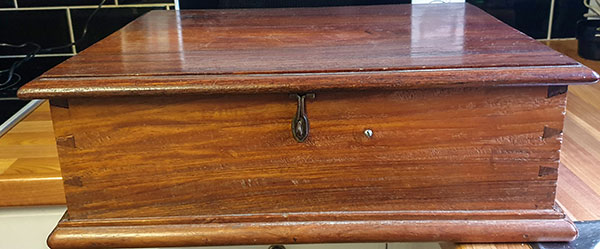
Ernest Smith also used old timbers from the mill to carve and make 5 wooden chests - one for each of his grandchildren. |
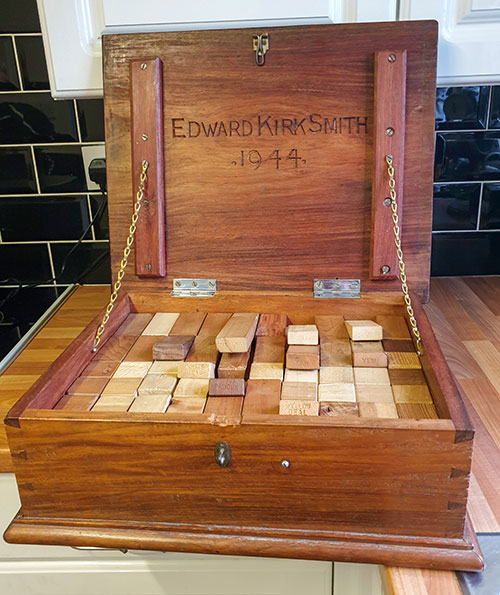 |
Box made by Ernest Geoffrey Smith for grandson Edward Kirk Smith 30th January 2021 |
 |
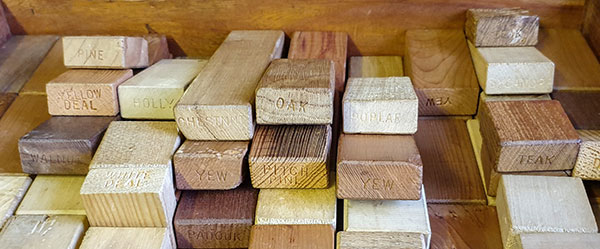 |
Box made by Ernest Geoffrey Smith for grandson Edward Kirk Smith containing bricks of different woods used in the building trade - 30th January 2021 |
|
The RAF were the first to live in the mill after conversion and were responsible for converting the cart track to the mill into a proper metalled drive. The officers lived in the mill and all their auxiliary staff lived in the mill cottage. King George Vl and the Queen Mother visited the pilots during their stay and Gladys Broughton also recalled seeing the Duke of Kent driving down Sovereigns Hill to the village in a maroon car. |
 |
 |
View from the meadow near the road looking east on 7th July 1938 |
Derek Neville and dogs in the late 1960s |
 |
 |
|
Views of the mill pond on 7th July 1938 |
||
 |
1938 |
During the war the Mill was used as an officers' mess for staff based at RAF Matlaske. The pilots lived in the mill itself while the cooks and other staff lived in the cottage. Some brave individuals would dive into the mill pond from the flat roof section between the two dormers. On other occasions swans were fed with bread soaked in whiskey. When the drunken birds swam back upriver, they were unable to negotiate the first bend and would swim straight into the bank. On 15th June 1974 several airmen returned to the Mill for a reunion and presented Derek and Mary Neville with a framed map of old Norfolk that they had all signed: |
| B. Ashwell 222 Squadron 1941 - Spitfire Mk IIa & IIb J. H.Burgess 222 Squadron May 1941 - Spitfire Mk IIa & IIb Jack Cornwell Ex F/O Adjt. 601 Squadron - Hurricane Mk IIb & Bell Airacobra Mk I W. Duthaler H.Q. 1940 - 1942 John Fincham 19 Squadron 1941 - Spitfire Mk IIa R. M. D. Hall 222 Squadron, May 1941 - Spitfire Mk IIa & IIb N.B. Some of the handwriting was not easy to decipher although the above is believed to be fairly accurate. |
 |
 |
|
F/Lt Hogan (Adj) (fishing) & F/O Barnet - 1942 |
Sgt Hoots (Canadian) with fishing rod! and Scottie Torrence - 1942 |
|
 |
 |
|
F/Lt Hogan - 1942 with mystery unidentified building in the background |
Left to right: F/Lt 'Uppie', F/Lt 'Bartie' Bartlett, Sgt Eddie, Sgt Hoots, P/O 'Sammy' Samede - 1942 |
|
 |
Dr. & Mrs. Gerald 'Gerry' Clayton 1942 |
My father, the M.O., had to check all the new pilot recruits. He checked the 1st recruit for colour blindness using the charts with coloured dots. The recruit said 5. My father said he was colour blind and rejected him. The 2nd recruit said the same! So he was rejected. Likewise the 3rd. But the 3rd chap said he was definitely not, and for my father to check the key in the back. Yes, it was my father who was colour blind and he was 28 by then! Gerry Clayton - 7th January 2010 |
 |
 |
Ex RAF dinghy c.1959 |
Raft August 1967 |
 |
Raft and retriever Sirius c.1968 |
When Sir David Cunningham moved in shortly after the war, the gardens were overrun by moles, which were removed by attaching a hose to a car exhaust pipe and burying the other end in a mole hole. |
Sir David Cunningham employed three men, Donny Baxter, Willy Thompson and a Mr Bond, he had an operation and later took cyanide and was found alongside the river with his feet in it, very sad and Brian Hoolhouse was one of the people that went out to find him. Ivan Thompson - 19th October 2005 |
 |
Bypass bridge c.1956 |
 |
 |
The bridge where the bypass joins the millpool in 1956 |
Mid 1960s |
During the 1960s the footbridge bridge was swept away by floods and a simpler bridge was later rebuilt using telegraph poles and wood slabs. The above right hand photo shows Jim Bonham from Hawaii, Jonathan Neville, Derek Neville, Martin Ellis and dog Sammy. |
In the spring of 1961 the river burst its northeastern bank some 100 yards above the mill and reverted to what was probably its original course. |
 |
Jonathan Neville on the river island May 1961 |
|
 |
c.1957 |
28th December 2001 |
 |
 |
Looking west from the Mill cottage early 1970s |
Mill cottage and garden when used for afternoon teas c.1965 |
 |
 |
Edith Thaxter c.1968 |
Edith Thaxter and Rose Coles c.1970 |
Edith Thaxter was Gladys Broughton's sister and for many years they lived in the cottage next to the school. The oak bench in the background of the right hand photo above was shortly to be transported to Australia in commemoration of Blackburn's Island whose original name had been reinstated as a result of the book Blackburn's Isle written by Derek Neville tracing the voyages of David Blackburn. |
 |
 |
Members of staff in 1967 |
Derek & Mary Neville c.1970 |
 |
Marks made by the wheel still remain - 29th June 2003 |
 |
 |
The wheelrace to the breast shot wheel June 2003 |
The renovated brick arch and new concrete ceiling of 1938 |
During conversion to residential use in 1938, a new fireplace alcove was built on the site of the wheel housing and a section of the cast iron pitwheel was incorporated into the brickwork above the hearth. A millstone was used as the centrepiece of the floor and the two wooden benches were made from mill timbers. In the 1990s a glass plate was inserted into the lounge floor over the site of the wheel and the river can be seen rushing through below. Another millstone was used a the front doorstep and a further two were incorporated into the back lawn. All the millstones were French burrstones, which meant the mill was grinding wheat for flour. |
 |
The fireplace alcove in the 1960s with a section of the pit wheel over the fire |
 |
 |
Pitwheel section above the fireplace 31st October 2004 |
Pitwheel teeth showing wear from contact with the wallower |
 |
 |
December 2001 |
29th June 2003 |
 |
|
6th June 1999 |
 |
Brian Webster standing at the north gable 29th June 2003 |
In the 1960s new oak sluice gates were installed by H. Newton & Sons of Cley. The wheel bypass sluice had not been raised for some 10 years and the mill pool, which used to be some 12 feet deep, had silted up to within a foot of the surface over most of the pool area. When the new gate was raised the whole millpool boiled as a vast amount of trapped methane gas was released. Within a few weeks the water was back to its former depth. |
 |
Bypass sluice derelict in the 1960s |
 |
Newspaper advert - March 1982
|
 |
 |
Bypass in flood late '60s looking west |
Bypass 29th June 2003 |
 |
29th June 2003 |
 |
 |
15th June 2006 |
27th July 2006 |
 |
 |
Peter Downs beside the Hydroelectric generator 9th December 2006 |
6th September 2009 |
 |
 |
River Bure after flood warning between Corpusty and Brampton 15th June 2007 |
|
 |
RW 1783 to the north of the fireplace under 1st floor floorboards |
During renovation work in 1938, the builders discovered the inscription R.W. 1783 scratched in the plaster at the back of the water wheel and this was left intact. It was found again in April 2009 during the extensive alterations of that year. Local historian William Vaughan-Lewis, identified the RW initials as belonging to
Robert Ward, a bricklayer who was very active locally on the Wolterton/Mannington estate in the 1770s and 1780s. He may even have been the son of Valentine Ward who was active in the same trade during the 1740s.
|
 |
11th July 2009 |
My Dad [Sidney Wilch of the Walpole Arms] also worked at and ran the mill and he had a fish round. He would call the horse from the orchard but he wouldn't come so he would yell "Edith!" Mother would come and she would call "Jack!" and he'd come trotting over and Dad would put the harness on him. He would drive to the train station at Aylsham to get the fish. Joan (Nellie) Hall née Wilch - 20th November 2007 |
I'm researching my Bean, Beane, Bane, Baine ancestors originating to date from the village of Thorpe Market c.1757. Having a subscription to the British Libraries Newspapers online I've found an article in the 'Norfolk Chronicle' newspaper copy of Saturday 02.03.1833 relating to Mr John Cook Bean of Itteringham, Miller. The article report was of his Deed of Assignment, Indenture dated 26.02.1833 where he Assigned his estate to a John Windett of Plumstead and John Gambling of Buxton, miller. The 'Deed of Assignment' was deposited at the Office of William Repton, Solicitor of Aylsham, to date I'm unsure as to how or if it's possible to obtain a copy of this record of part of his life. Ken Maidens, Lincolnshire - 7th May 2013 |
Staying on the north coast and simply looking up Norfolk history.
Mary Hepworth Taylor - 3rd November 2021I then remembered a childhood holiday at Itteringham Mill.
It must have been approximately 1959 early 1960 and it has left a chilhood memory.
I note that a Derek and Mary Neville were living there at the time, although I have no memory of them.
My brother approximately 8yrs and I must have been 5yrs old. I remember the name well and possibly it was due to falling into a bed of sticking nettles, crossing a tiny wooden bridge in a field very near to the Mill House.
As for being allowed to walk about alone at such an early age passes belief now thinking about it, although both my brother and I were obedient and responsible children.
|
 |
 |
Strutt & Parker sale brochure - 2023 |
|
Itteringham Mill For Sale
|
Set in the picturesque Norfolk countryside, Itteringham Mill is a home of immense character and charm. This stunning historic property has been lovingly restored to provide modern living with a perfect blend of period features and sustainable design. The original mill, dating back to the early 18th century, has been transformed into a spacious and light-filled home, with over 4,500 sq. ft. of beautifully designed living space across three floors. |
 |
 |
Sowerbys sale brochure - March 2025 |
|
 |
Enclosure Map |
Itteringham Tithe Map 1839 (full size) |
 |
Tithe Map 1841 |
 |
O.S. Map 1884 Courtesy of NLS map images |
 |
O.S. Map 1885 Courtesy of NLS map images |
 |
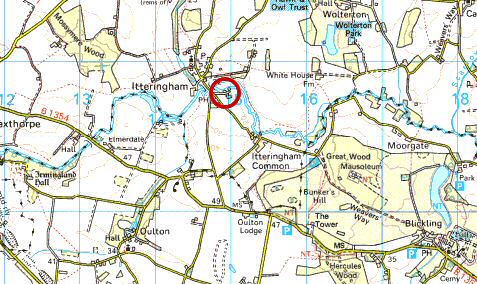
O.S. Map - unknown date - c.1950 The mill dam is clearly shown to have extended under the road bridge, almost up to Bintry farm |
 |
O.S. Map 2005 Image reproduced under licence from Ordnance Survey |
Reign of Henry II (5 March 1133 - 6 July 1189): Mill working
White's 1845: Frederick Copeman, corn miller, also Blickling Mill
Kelly's 1854: Frederick Copeman, miller & corn merchant
e's 1864: James Brown - corn miller, maltster and farmer
Kelly's 1879: Benjamin Cook
Kelly's 1922: Walter H. Marcom, miller (water) |
If you have any memories, anecdotes or photos please let us know and we may be able to use them to update the site. By all means telephone 07836 675369 or
|
| Nat Grid Ref TG 14923057 | Copyright © Jonathan Neville 2025 |