 |
c.1912 |
Weybourne Mill Spring Beck |
|
c.1912 |
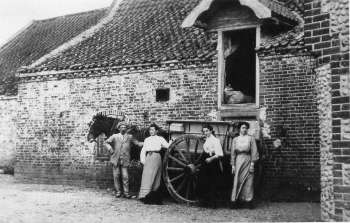
Weybourne mill's present structure could be the same age as the mill house, which is thought to date from 1729, when the village was known as Wabourne. Both were built from brick and beach flints with a Norfolk pantiled roof. The house could well have been enlarged later and has the iron initials E.N. (Edmund Nurse) on one gable. In 1938 Claude Messent wrote that Weybourne Mill was the second smallest in the county after Little Cressingham. The picture above shows Mr. and Mrs. Ellis Beales with their daughter and maid standing outside the mill, possibly just before the first world war. |
 |
 |
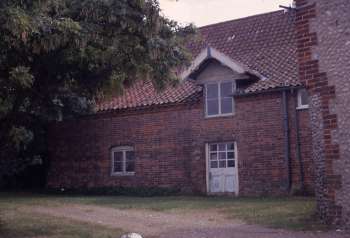
August 1967 |
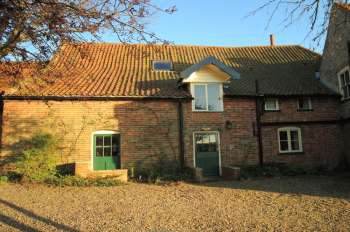
7th April 2003 |
Weybourne Mill was powered by one of the few overshot wheels in Norfolk as there was insufficient water available to power the more commonly found and less efficient breast or undershot wheels. Overshot wheels are comparatively rare in Norfolk due to the mainly gentle terrain. The only other mills to use this system that I have found so far were at Brandiston, Buxton (one of the two wheels) Foulden, Hingham, Mundesley and Tharston. The present building was built some time before 1723 and it was shown on the earliest O.S. maps in 1838. For many years it was worked in conjunction with Weybourne_postmill on the same property. In the 13th century a priory was founded at Weybourne and it is likely that it owned both mills. |
Edmund Nurse was born in Trimingham and baptised on 25th May 1769. He went on to marry Mary Mallis née Larkman of Weybourne on 12th October 1801 in Weybourne church. |
To Millers. To be Sold by Private Contract.
An eligible FREEHOLD ESTATE situate in Weybourne in the County of Norfolk consisting of a water mill driving two pairs of French Stones & a Windmill driving two pairs of stones with Flour Mills & all the going Gears in each complete; also a commodious Dwelling House, Barn, Stables & other convenient Outbuildings & 4 acres more or less of excellent Arable Land. Half the Purchase Money may remain on Mortgage. Apply to Messrs. BALLACHEY & SON, Solrs. Holt. Norfolk Chronicle - 20th March 1841 |
During the 1800s when the mill and much of the Weybourne areas were owned by William J. Bolding, it is reputed that he turned a blind eye to smuggled goods landed on the beaches bordering his property and was always duly rewarded with a couple of tubs left discretely on his doorstep. |
WABOURNE
To Millers To be Let with Possession at Maichaelmas next A Water and Wind CORN MILL, Dwelling house, suitable Outbuildings with 3 acres of Land and a Baking office if required doing a good business. Particulars of Mr. J. Bolding, Wabourne, July 4, 1846 Norfolk Chronicle & Norwich Gazette - 11th & 18th July 1846 |
 |
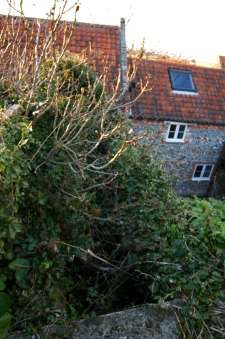 |
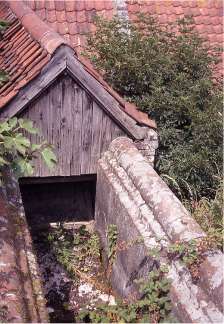
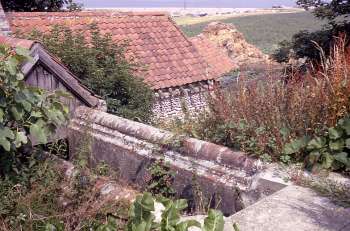
Leat in August 1967 |
Leat in April 2003 |
 |
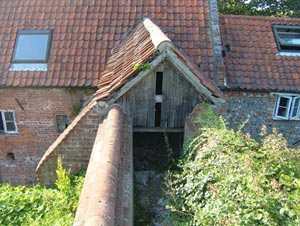 |
Mill leat in August 1967 with the sea behind |
12th July 2006 |
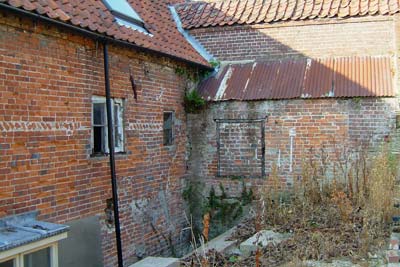 |
Original leat housing and brickwork 12th July 2006 |
Over the years the wheelhouse walls were marked by the turning wheel or foreign bodies lodged in it. Two sets of not quite concentric marks provide evidence that the waterwheel was replaced or rehung, possibly in 1855 when W.J.J. Bolding overhauled the mill, leaving his initials in the concrete. Later the wheel was removed and a Thompson turbine was installed by Samuel Nott in about 1900 in order to improve efficiency. Unusually the two pairs of stones were driven from above, the only other Norfolk mills I have found so far that shared this arrangement are Hunworth, Snettisham and Stoke Holy Cross. |
 |
 |
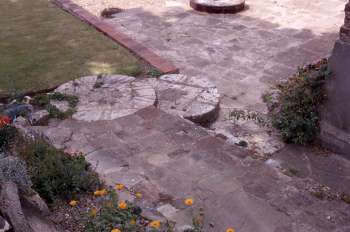
Millstone steps of French burrstone August 1967 |
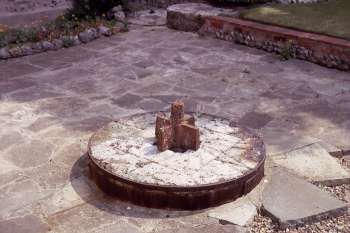
Bedstone with a cross-tailed gudgeon axle bearing on top |
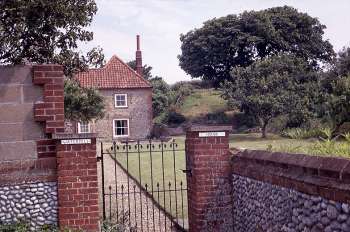 |
Water Mill House August 1967 |
When Robert and Edmund [Nurse] emigrated in 1849, the farm and mill were purchased at auction by their eldest brother James (born 1793) in Weybourne where he trained as a miller before buying the village store and postmill in Hindolveston. There he married another Platten, Martha, daughter of an owner farmer from Wood Norton, Samuel Platten, and his second wife Rebecca Sawyer from Foulsham. He had a son in Hindolveston in 1835 and christened James Platten Nurse who married Ester from Swanton and had two children before following his father as miller in Kelling. |
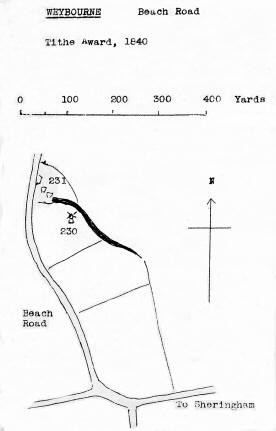 |
Tithe map 1840 |
Tithe Award 1840 |
Map 1838 |
| No. 230 : Mill Close - post mill on roundhouse. Arable | 2a. 1r. 38p. |
| No. 231: House, mill etc. watermill on millpond. Pasture | 1a. 0r. 10p. |
| 3a. 2r. 8p. = 19s. |
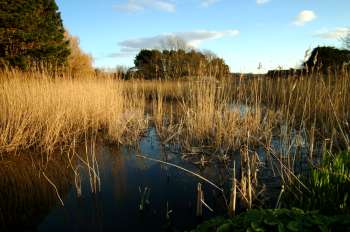 |
Weybourne dam 7th April 2003 |
Thomas Armes owned Weybourne watermill during at least the second half of the 1830s. Thomas, who was born in Gorleston c.1774, married Mary Hammond on July 9th, 1823 at Weybourne. The marriage was witnessed by John Pilch and Mary Dack. On July 20th 1823, Mary gave birth to a daughter, Martha. They then had a son Thomas, born 28th November 1824 a second daughter Marianne on 6th November 1826 and another son, John, born 2nd November 1827 and then a third daughter Elizabeth, baptised January 26th 1834. Thomas was listed in the Holt census of 1851 as being 77 years old and a landowner. |
The Bankruptcy Act 1861
In the County Court of Norfolk holden at Norwich John Dawson of the parish of Weybourne near Holt in the County of Norfolk, Farmer and Miller, having been adjudged Bankrupt on the 3rd day of July 1869, a PUBLIC SITTING ... will be held at the said Court at the Shirehall, Norwich Castle on the 27th day of August 1869 at 10 o'c in the Forenoon precisely, the day last aforesaid being the day limited for the said Bankrupt to surrender. The Registrar of the Court is the Official Assignee and Isaac Bugg Coaks of Norwich aforesaid is the Solicitor acting in the Bamkruptcy. |
THOS. H. PALMER Registrar |
| Norfolk Chronicle - 14th August 1869 |
WEYBOURNE near Holt
To be Sold by Auction by William Leggatt under instructions received from the Assignees of Mr. John Dawsonin Court of Bankruptcy on Friday September 24, 1869 the Live and Dead Farming Stock, MILL UTENSILS consist of about 300 corn and flour sacks, weighing machine and weights, beam scales and weights, dressing machine, sack barrows, ladders, straps, flour mill cloths, sail types, new step brasses, wrenches, sack chain etc. etc. The Sale will commence with the Mill Utensils at the Mill at 11 o'c Catalogues of the Auctioneer. Norfolk Chronicle - 18th September 1869 |
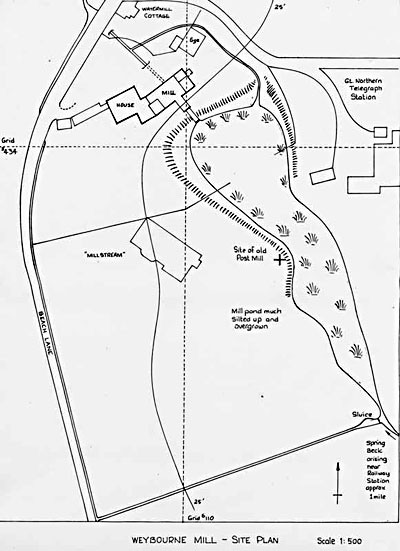 |
Site plan - August 1983 |
 |
 |
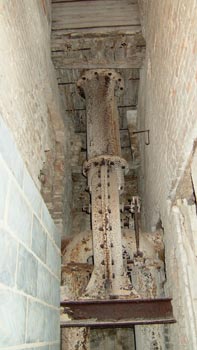
Turbine 12th July 2006 |
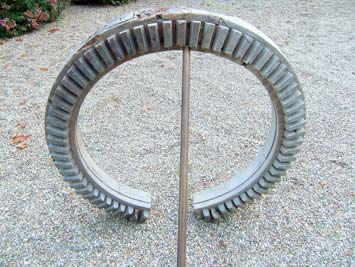
Crownwheel section 19th July 2006 |
 |
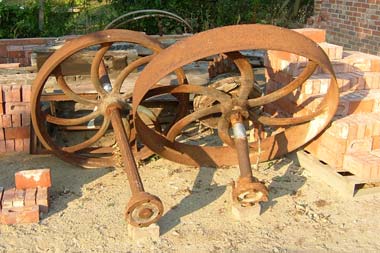 |
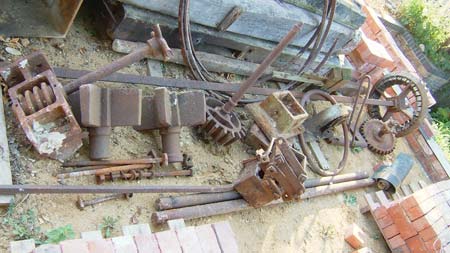
Machinery removed during renovation 12th July 2006
|
|
 |
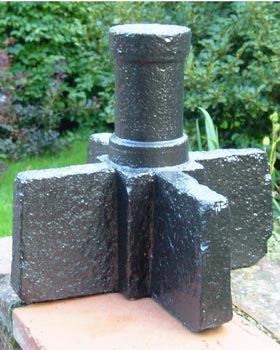 |
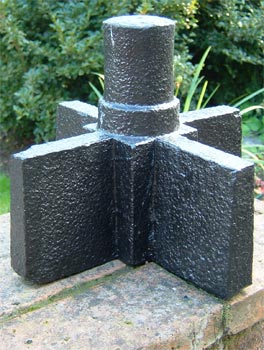
Cross tailed gudgeons September 2006 |
|
I have discovered that my Great Uncle John Dawson was the miller at Weybourne from 1836 to 1869. It would appear that he made an interesting career change. Prior to taking over the lease at Weybourne he was a brick burner in Sprowston having been born into a brick making family in Swanton Novers. |
My memories of the house go back to 1939 when my sister Christine and I were evacuees from Gravesend Kent at the start of WW2. We were told to call Mr. and Mrs Beckett Auntie Dot and Uncle Dick. I was aged 5 and Christine was 7. I have very fond memories of those times. The things I remember was a well in front of the house that was used to draw water with bucket on a rope, and Uncle Dick being a farmer. He told me that I could have a horse for sixpence and I begged Auntie Dot for the money not knowing he was kidding.I also remember the pebble beach and watching some soldiers returning from fishing with a boatload of fish. Also remember a windmill nearby. I think that I was only there for a few months before being moved to a big building being used as a boarding school for evacuees and then going home to Gravesend. I wrote a letter after the war to Aunie Dot and she did reply. I hope before it's too late to visit Weybourne and see Watermill House. I have lived in New York City for the past 50 years. |
My grandfather V.H. Rees and family owned Watermill House and the adjacent Watermill Cottage, around 1956.
They bought it from a Mr Andrews. Nigel Rees - 27th April 2016
|
 |
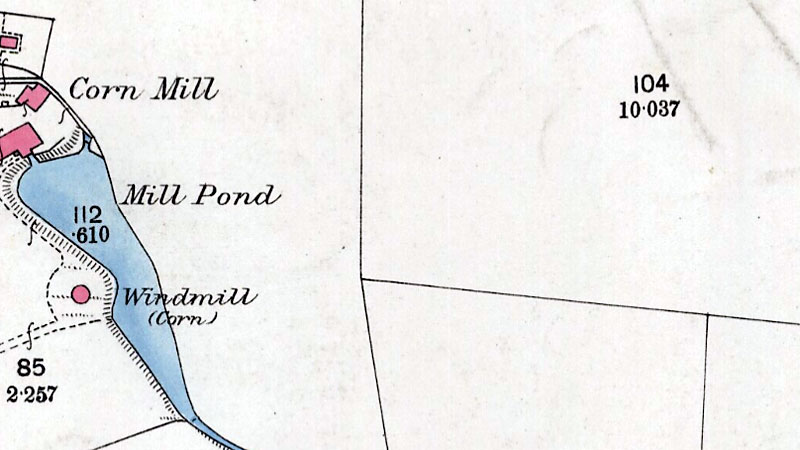 |
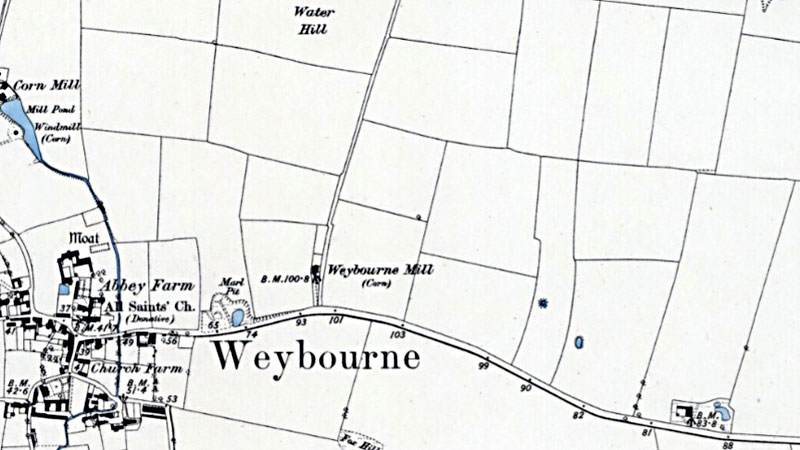
O. S. Map 1886 (not to scale) |
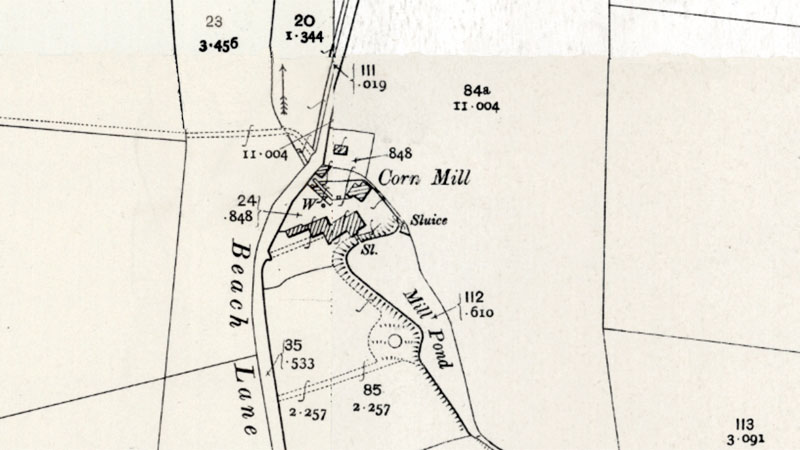 |
O. S. Map 1904 |
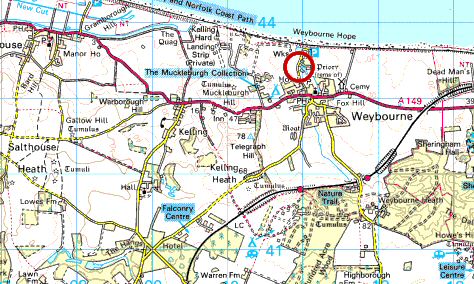 |
O.S. Map 2005 Image reproduced under licence from Ordnance Survey |
White's 1836: Cooke Nurse, victualler, Ship White's 1836: John Nurse, farmer White's 1845: John Nurse, farmer (owner) White's 1890: Mr. William Thomas Bird Kelly's 1900: Walterr Nott, farm bailifff to Mrs. Dixon Kelly's 1900: Robert Seaman, farm bailiff to Samuel Nott esq Kelly's 1904: John Otty, farm bailiff to Samuel Nott esq |
c.1070: Area around Weybourne including 2 mills, given by William I to his sister's son, Hugh Earl of Chester
1759: The mill was sold as part of the estate to Horatio Lord Walpole for a combined total of £2,300
15th October 1841: Indenture of Lease and Conveyance from Thomas Armes to John Bolding (sale for £1400)
Kelly's 1854: John Dawson, farmer (and corn miller)
White's 1864: John Dawson, farmer & corn miller 3rd July 1869: After some 33 years at the mill, John Dawson was declared bankrupt September 1869: Personal effects, mill utensils & farming stock of John Dawson advertised for sale by auction Kelly's 1879:
William Thomas Bird, farmer & miller
Kelly's 1896: William Johnson Jennis Bolding, brewer, maltster, landowner, farmer & miller (water)
1900: Samuel Nott had bought the mill and soon after this he removed the waterwheel and installed a turbine Kelly's 1933: Old Mill house listed as a private residence owned by Richard Beckett
March 2003: Mill and adjoining buildings advertised for sale by Thomas Gaze at a guide price of £775,000 |
If you have any memories, anecdotes or photos please let us know and we may be able to use them to update the site. By all means telephone 07836 675369 or
|
| Nat Grid Ref TG1099 4341 | Copyright © Jonathan Neville 2004 |