 |
|
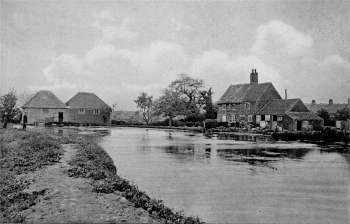
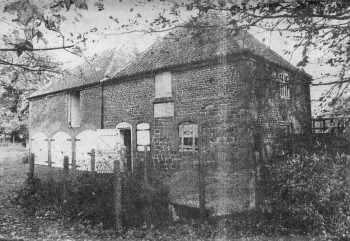
c.1910
|
|
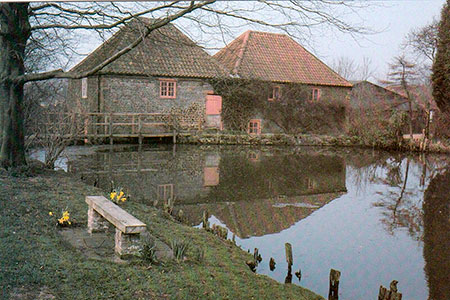
Snettisham Mill
River Ingol |
|
|
c.1910
|
|
Snettisham
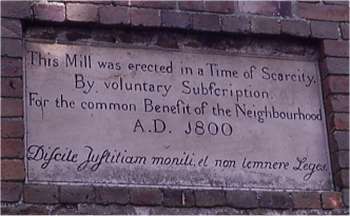
watermill, in Southgate, was built in 1800 for £800 at a time when bread was scarce
and it was built by the community for the community. It is probable that
it was built on an existing site although virtually no records have so
far been found apart from the fact that Thomas Stonne was a Snettisham
miller in 1626. At the time of Domesday there were seven mills in Snettisham
- more than in any other Norfolk village. |
 |
|
c.1929
|
At the time
the mill was built a significant part of farmworkers' wages could be taken
up by the cost of having corn ground into flour. Local people would bring
in grain they had grown themselves or gleanings they had acquired. |
 |
 |
|
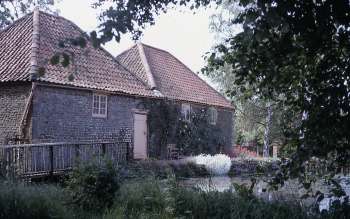
June
1968 |
|
Normally, when
flour leaves the stones, it passes down a chute into bags. However, at Snettisham
it passed down a chute into bins from which the flour was then measured
out to the poor of the parish. |
|
SNETTISHAM |
 |
|
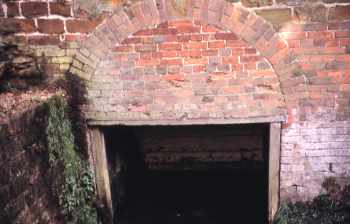
The
wheelhouse with the intact wheel June 1968
|
 |
|
c.1970 |
 |
 |
|
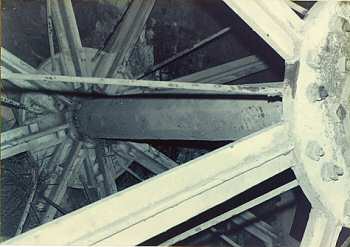
Wheel
spokes and axle May 1977
|
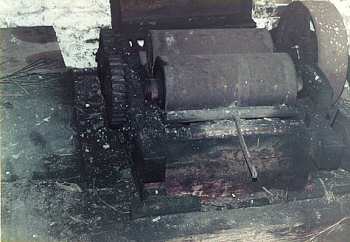
Belt
driven roller mill May 1977 |
| GENERAL VIEW OF THE
AGRICULTURE OF THE COUNTY OF NORFOLK BOARD OF AGRICULTURE By the Secretary of the Board 1813 Chapter X1V Section 1V The Poor p.41 |
|||
| Chapter X1V | Section 1V | The Poor | p.491 |
An establishment at Snettisham,
which has been found of the greatest use to the poor and has answered every
expectation is a subscription water-mill; it cost 800£ and a miller
is employed, at 20s. per week, to grind, at 4d per bushel, for all persons,
whencesoever coming. Also in 1804 Edition |
|||
 |
|
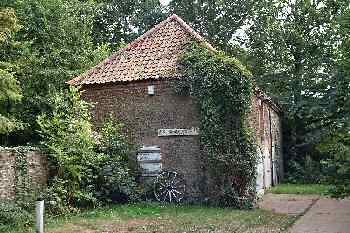
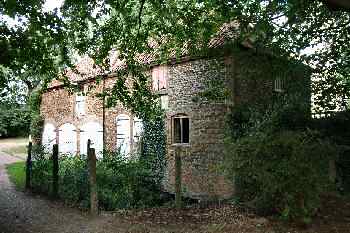
25th
August 2003
|
 |
 |
|
1983
|
25th
August 2003 |
In 1981 the
mill was bought by Robin and Audrey Nott who set about renovating the buildings,
a new roof being the initial priority. Much of the original machinery lay
intact. By 1984 the mill was back in operational order and able to provide
milling demonstrations to the public. |
 |
 |
|
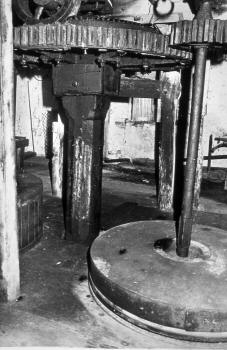
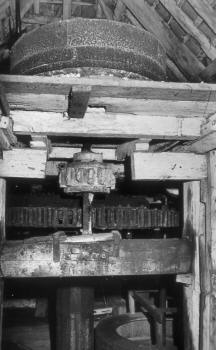
Two
pairs of lower stones 1980
|
Upper
pair of stones 1980 |
 |
 |
|
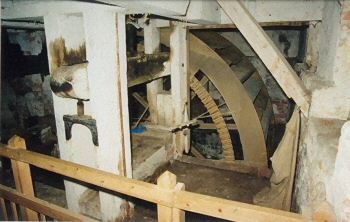
The
wheel, September 1998
|
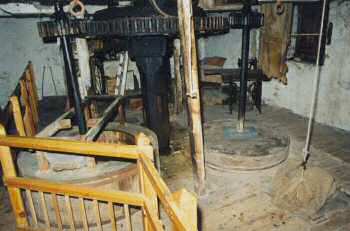
Crown
wheel, stone nuts and stones, September 1998 |
|
The Water Mill enjoys an enviable position, having
East/West elevations with lovely established gardens which include the
Mill Pond itself which has recently been dredged. The whole site extends
to about an acre subject to survey. This is a unique opportunity to acquire
a Grade II Listed historical building. The main structure is of local
carrstone under a pantiled roof and measures approximately 22' x 52' and
is arranged on two floors and has the original mill wheel in working order.
The River Ingol flows through the Mill Pond and out through the sluice
gate which is controlled by the Water Mill. |
 |
|
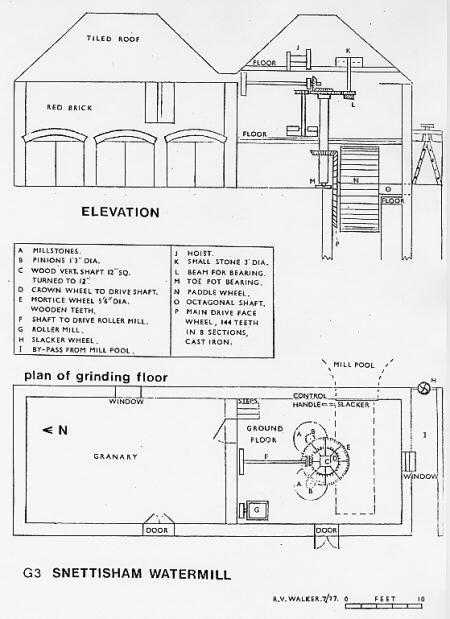
Plan
from NIAS Journal Vol. 2 No. 3
|
 |
|
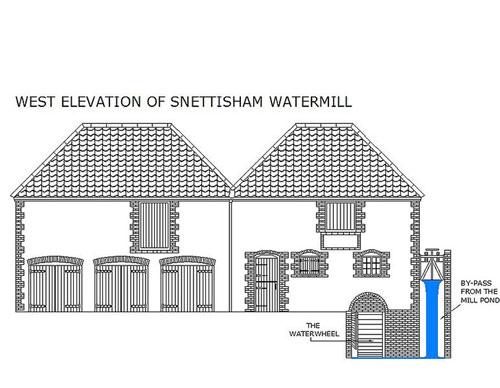
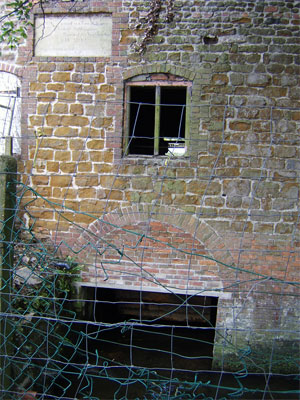
West Elevation |
 |
|
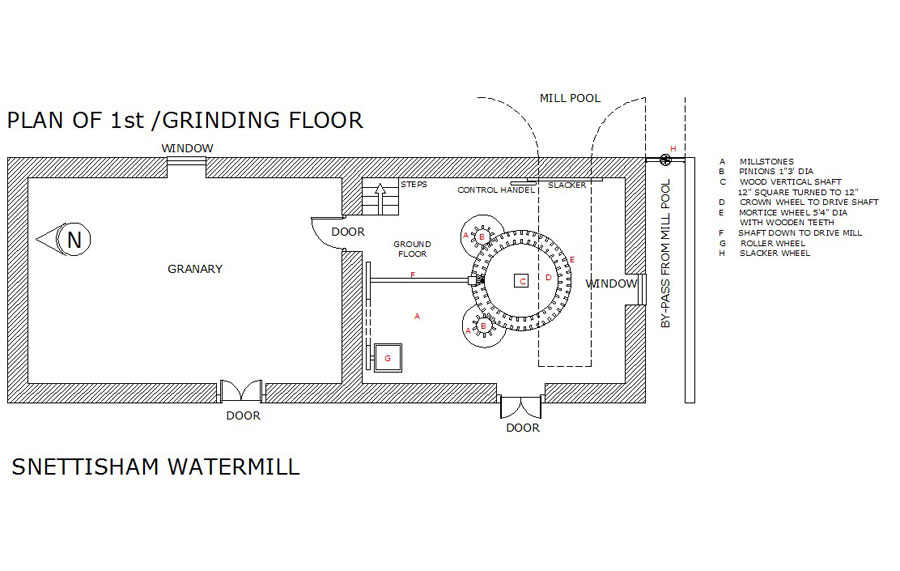
Mill Grinding Floor Plan |
 |
|
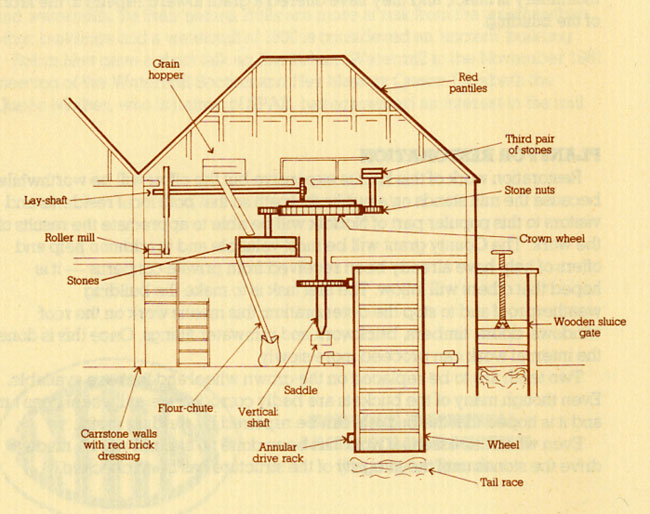
Cutaway machinery layout from official pamphlet - 1982 |
 |
|
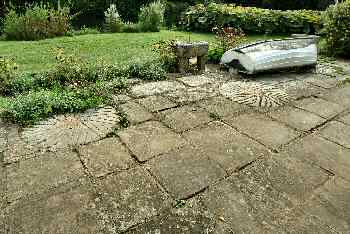
Old
millstones inlaid into the mill house patio 2003
|
The Lynn News Village Supplement of 19th April 2004 reported that village's Watermill & Heritage Centre Steering Committee had made an application to the Lottery Fund for some £300,000 to go towards purchase and restoration of the mill. Unfortunately, the application was unsuccessful. |
In 2008, new owner, Michael Saunders applied for planning permission to convert the granary section of the mill to holiday let accommodation whilst allowing the mill to be open to to the public on set days. Although supported by members of the committee formed to save the mill in 2003, the application was objected to by the Mills Section of SPAB (Society for the Protection of Ancient Buildings), mainly on the grounds that the physical structure of the mill and its use would be dramatically and probably permanently altered. |
|
I believe the Robert Chapman who was the first miller at Snettisham had previously been at Castle_Rising:- his marriage licence before marrying Elizabeth Plane (they were I believe the parents of the John Chapman who took over Snettisham mill after Robert) states: 1805 Marriage Licence Robert Chapman, occupation Miller, of Castle_Rising ( have copy of this Licence) John Chapmans baptism states: baptism 18 September 1813 at Castle_Rising John Chapman son of Robert, a servant in the cornmill, and SARAH. |
 |
|
August 2011 |
|
Snettisham watermill money to go into church heritage room |
EFFORTS are being made to release £1,660 from a small charity to create a new heritage room in Snettisham's church. |
|
Snettisham: Call to end Watermill fund saga |
A PUBLIC meeting could be held to discuss winding up a defunct restoration fund. |
|
I am a mill enthusiast from Soham in Cambridgeshire but my family have a holiday caravan in Heacham so i am always keeping an eye out for the local mills. |
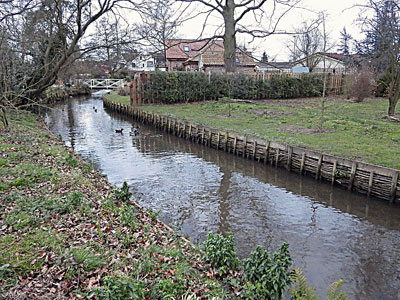 |
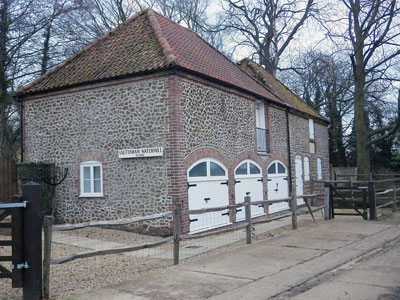 |
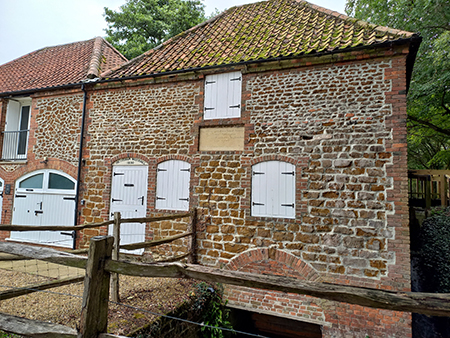
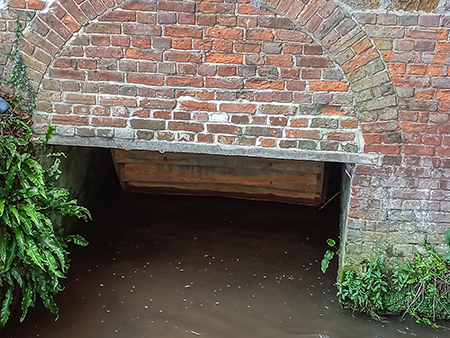
Mill dam 19th February 2014 |
Mill 19th February 2014 |
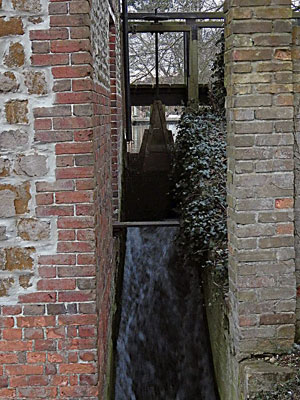 |
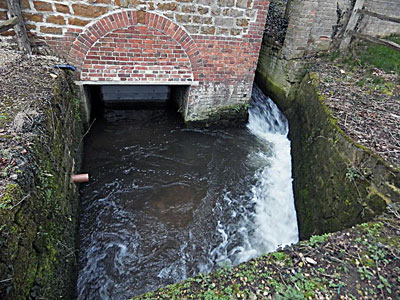 |
Bypass sluice 19th February 2014 |
Wheelrace 19th February 2014 |
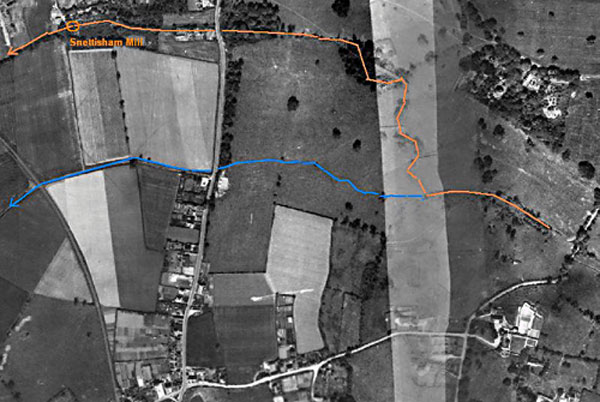 |
1946 aerial photo showing river routes |
| 1946 aerial photo of the Ingoldisthorpe/Snettisham area, showing what I take to be the old course of the river in blue and the new (present) one in orange. The old one has evidently been straightened in more recent centuries. Tim Holt-Wilson - 3rd March 2014 |
I stumbled across your page whilst trying to find out about my family history in Snettisham. The photo believed to be Sarah Chapman (Elizabeth Susannah Wright) is my Great Great Great Grandmother! The information you have is in keeping with what I've found out myself. You mention she had a daughter Ellen, after marrying William Wright. This daughter was Ellen Elizabeth Wright, who went on to marry Henry Whitby. One of Ellen and Henry's daughters fell into the water at the mill
and died aged 2. They lived in a cottage nearby. They had quite a few children, including William "Bill" Arthur Whitby, who lied about his age to join the Norfolk Regiment 2nd Btn. and fought in the Boer War. He was taken prisoner but returned and later fought in the 1st World War with his younger brother Guy Marriott Whitby, who was killed in action. He later was a sea defense officer during the Second World War. Bill was quite something! His duties in WW2 were at home, patrolling
Snettisham beach, drinking and smoking like a trooper, with his pet parrot!
Finally discharged due to old age. |
 |
 |
31st August 2023 |
Wheel still in situ - 31st August 2023 |
Snettisham Mill advertised for sale for £370,000 |
Grade II listed Snettisham Water Mill at auction for £295K |
A grade II listed water mill currently being used as a holiday let is going up for auction this week. |
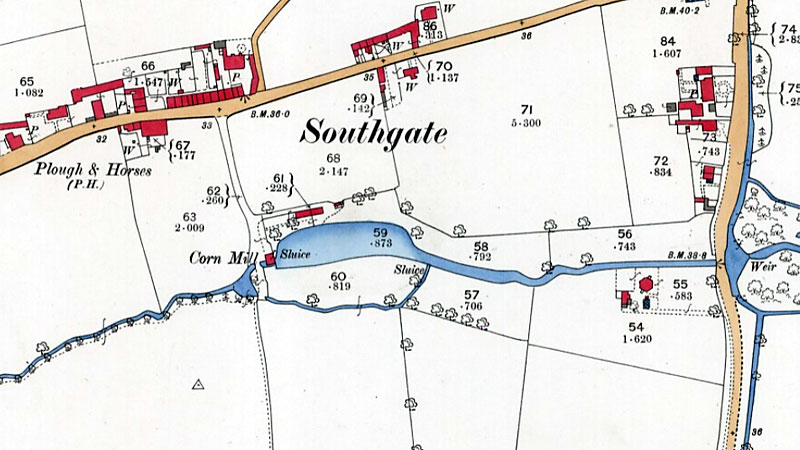 |
O. S. Map 1885 |
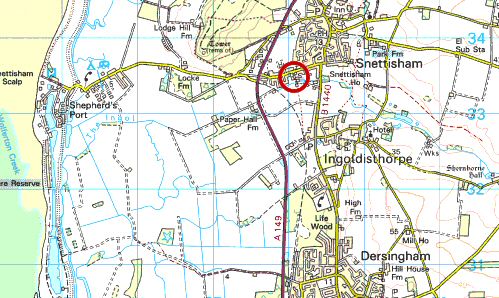 |
O.S. Map 2005 Image reproduced under licence from Ordnance Survey |
|
1626: Thomas
Stonne L.D. Barnes
- various alterations including garden landscaping
2004: Lottery grant unsuccessful |
If you have any memories, anecdotes or photos please let us know and we may be able to use them to update the site. By all means email or telephone 07836 675369. |
| Nat Grid Ref TF68083346 | Copyright © Jonathan Neville 2003 |