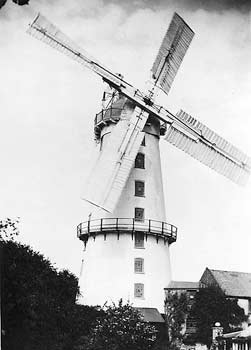
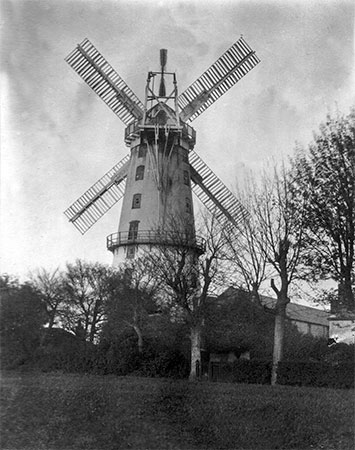
Mill working - c.1920
|
Sutton towermill |
|
|
Mill working - c.1920 |
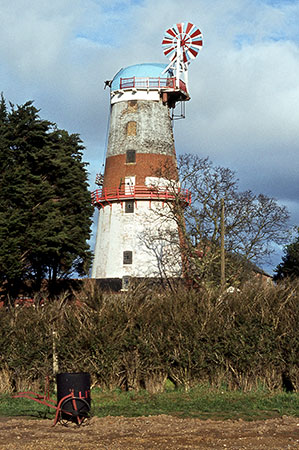
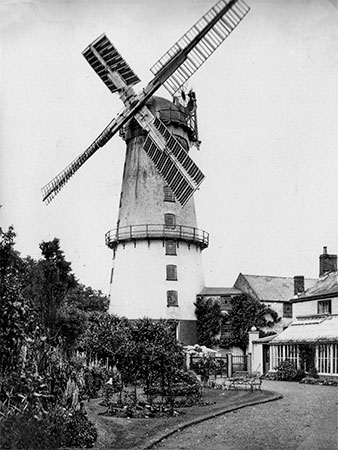
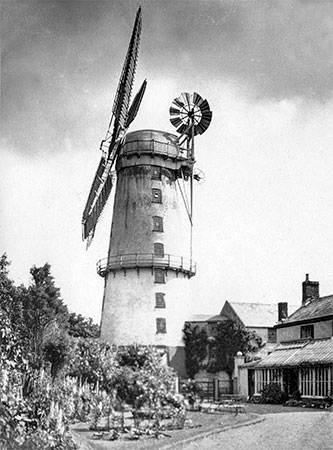
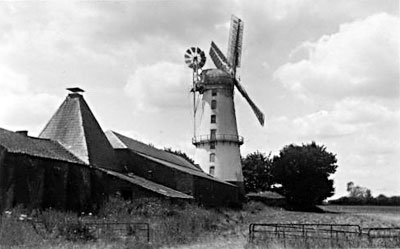
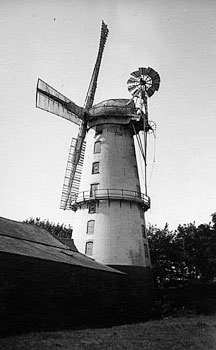
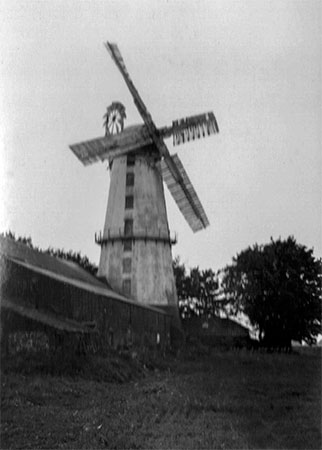
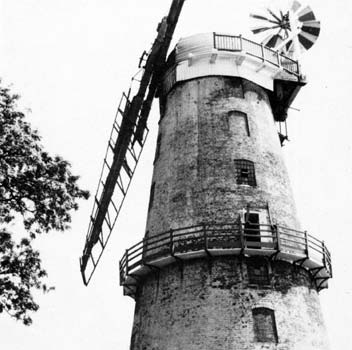
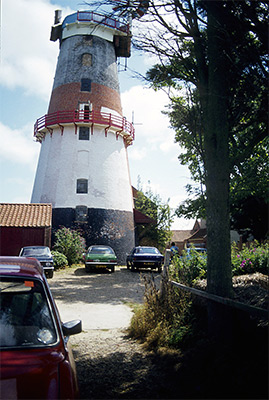
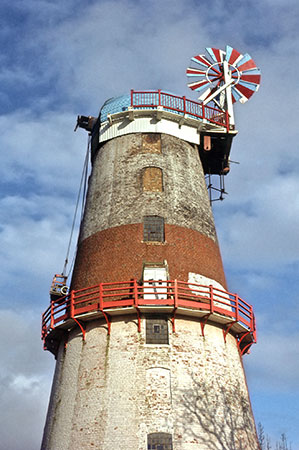
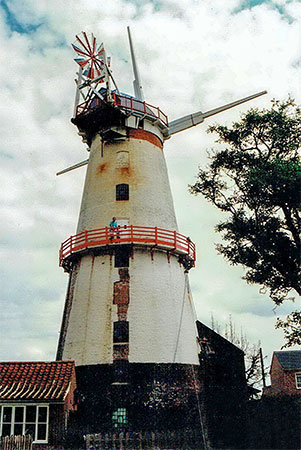
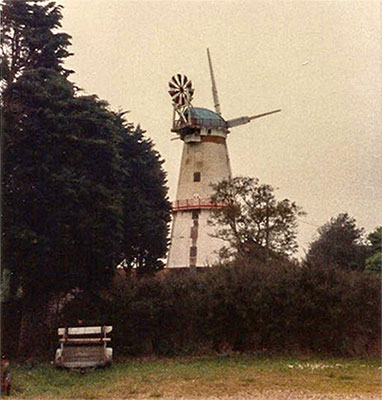
Sutton mill was built in 1789 with 8 floors. When it was rebuilt after the fire of 1861 an additional floor was added and the common sails were replaced by patent sails. The nine storey mill was topped by a traditional Norfolk boat shaped cap and had a gallery and petticoat. By 2005, Sutton mill at 67' 6", was reputed to be the tallest remaining windmill in the county although the unconfirmed height of Lakenham_Peafield was said to be. almost 80 ft. The mill became Grade II listed before 2007. |
Sutton's 9 storey tower was about 67' 6" to the curb and 79' 6" to the top of the Norfolk boat shaped cap with a chain pole. The stocks were 12ins. square at the centre. The four double shuttered sails, struck by rack and pinion had a span of 73 feet and were 9ft. 4ins. wide. Each sail had 9 bays of 3 shutters and at one time they were recorded with 10 bays of 3 shutters. |
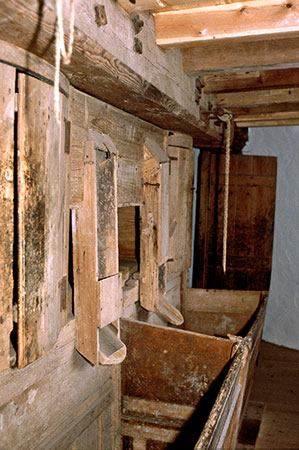
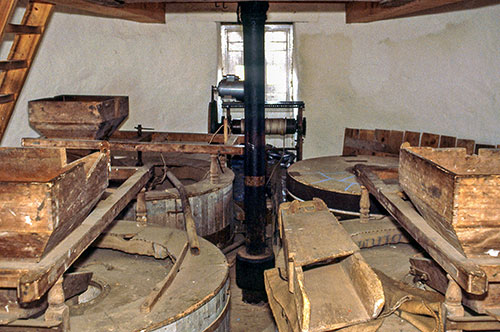
On the sixth floor of the tower there were 4 sets of stones, more than any other mill in the country. The walls were over 3 feet thick, the tower outside diameter was 33 feet and the diameter at the curb was 16 feet. |
Unusually, the 8 storey mill was built on the site of an earlier towermill that burnt down in 1789. When rebuilt, the mill was large enough to use 4 common sails to power 4 pairs of stones, 2 flour mills, jumper and cylinder. However, by 1858, the common sails had been replaced by 4 patent sails. A stage was set around the tower on the 5th floor. |
|
In 1857 the mill was producing 10 to 12 score or lasts per week, this being equal to 200 to 240 coomb sacks, meaning each pair of stones was producing 50 to 60 coombs per week. |
 |
|
c.1925 |
 |
 |
|
c.1926 |
c.1926 |
 |
 |
Mill working c.1930 |
11th September 1934 |
 |
 |
|
Mill working - 30th May 1939 |
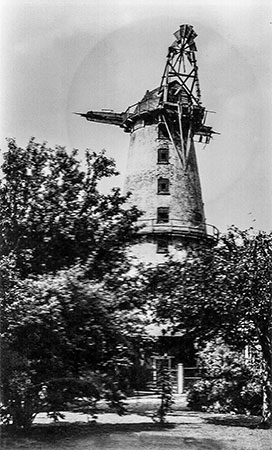
Mill after lightning strike - 1940 |
|
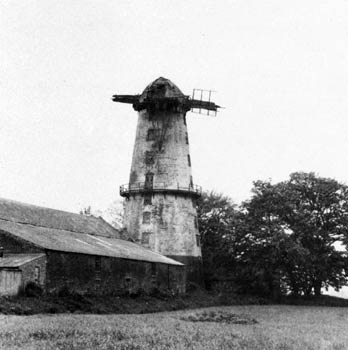
The mill suffered a serious fire in 1861 and was then hit by lightning on Monday 4th July 1875 at 4.00 p.m. with the lightning bolt hitting one of the sails and then passing down through the centre of the mill via the sack chain. Some of the staff were within three feet of the chain at the time but escaped injury. However, the mill was again struck by lightning in 1940 when the sails were hit, causing a fire. The mill, which by this time had given up grinding corn and was exclusively producing animal feed, ceased to work from that time. |
 |
 |
23rd October 1970 |
19th May 1980 |
Whereas I, William Read of Sutton, Innkeeper, having rescued a Mare belonging to me, distrained by Mr. John Bygrave, junior, damage feasant and also abused the said Mr. Bygrave, who in consideration of my paying one pound, to be distributed in bread to the poor of the said parish of Sutton, and expences and asking the said Mr. Bygrave's pardon, publicaly, has declined commencing actions for the above offences; I do therefore hereby beg the said Mr. Bygrave's pardon accordingly. Witness |
|
| George Rust | WM. READ |
| Norfolk Chronicle - 29th May 1813 | |
 |
August 1982 |
WANTED IMMEDIATELY A JOURNEYMAN MILLER. Apply to Mr. John Bygrave, Sutton Mill. N.B. A Single man will be preferred. Norfolk Chronicle - 19th August 1815 |
WANTED Now or at Michaelmas next A JOURNEYMAN MILLER, one who perfectly understands his business and can write a good plain hand, may meet with constant employ, By applying to John Bygrave, Sutton Mills, Norfolk. N.B. A Single man will be preferred. Norfolk Chronicle - 20th September 1817 |
Thomas Goose's Creditors Thomas Goose of Hickling, Farmer assigned personal Estate and Effects to John Bygrave of Sutton, Miller for benefit of creditors. Deed of Assignment ... Norfolk Chronicle - 15th December 1821 |
 |
 |
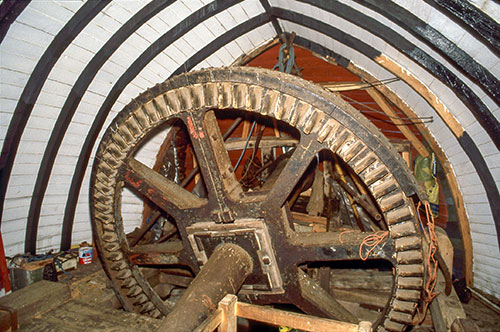
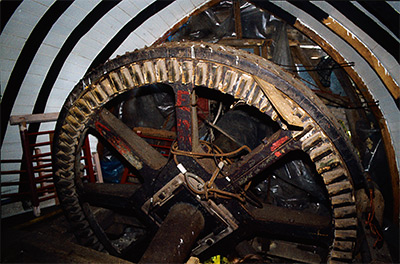
Brakewheel - August 1982 |
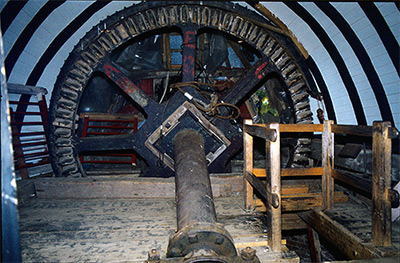
Windshaft - August 1982 |
 |
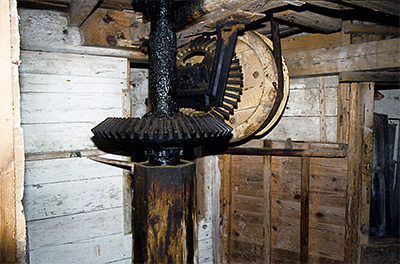 |
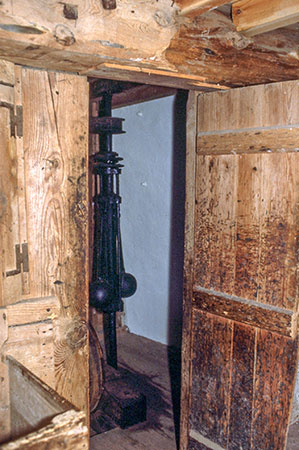
Upright shaft - August 1982 |
Gearing to horizontal shaft - August 1982 |
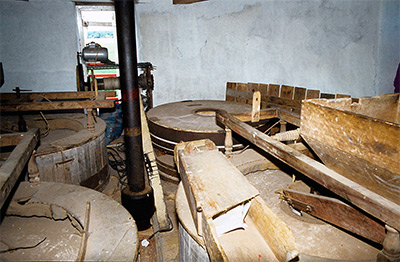 |
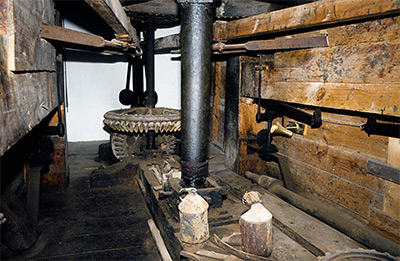
Stonefloor - August 1982 |
To Millwrights Any Persons that are desirous of Contracting for the Building of a TOWER WINDMILL on the premises of William Warner Esq. are desired to send their Proposals free of postage to the Kings Arms Inn, North Walsham on the 3rd day of December next. N.B. For a Plan of the Work etc. apply to Mr. John Bygrove, Sutton Mills, Norfolk. Norfolk Chronicle - 20th & 27th November 1824 |
| Tithe Award 1842 Map. Pratt & Son, Surveyors, Norwich, 1841 Owner: John Bygrave Occupier: John Bygrave Mill shown on |
||||
No. 204 |
Malt House Piece mill |
Part of |
42a. 0r. 3p. |
£19. -. 6 |
|
Mill shown as large towermill with a stage. |
|
August 1982 |
|
 |
15th April 1984 |
|
|
 |
15th April 1984 |
|
|
 |
15th April 1984 |
|
|
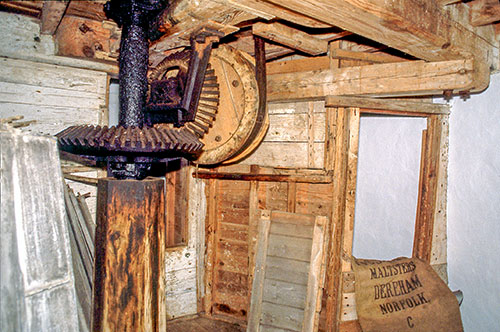 |
Stone floor - 15th April 1984 |
Auxiliary drive - 15th April 1984 |
|
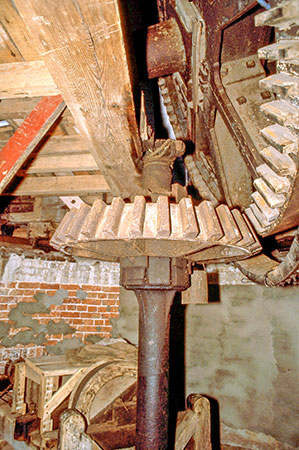
Brakewheel - 15th April 1984 |
|
To Millers and Maltsters |
|
 |
1989 |
1989 |
| To be Let |
|
To be Let |
|
Mill and Cart horses etc. |
|
To Painters |
 |
June 1988 |
|
|
1989 |
1989 |
|
Situations Vacant |
|
SUTTON - THUNDERSTORM |
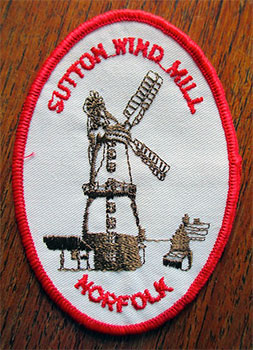 |
Cloth badge c.1990 |
|
SUTTON. Thunderstorm. |
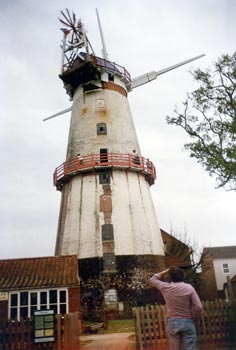 |
August 1992 |
|
AGIST STOCK |
 |
 |
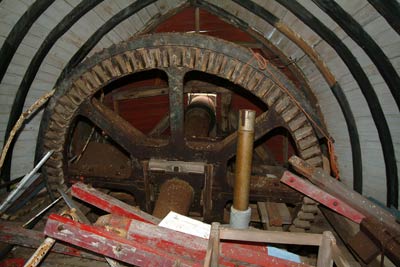
Windshaft inside the cap 4th June 2004 |
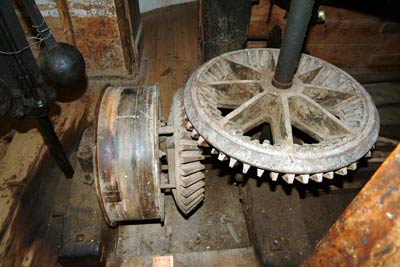
Gearing to a belt drive 4th June 2004 |
 |
 |
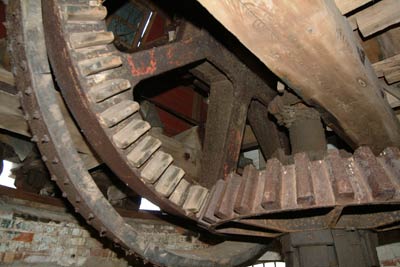
Brakewheel and wallower 4th June 2004 |
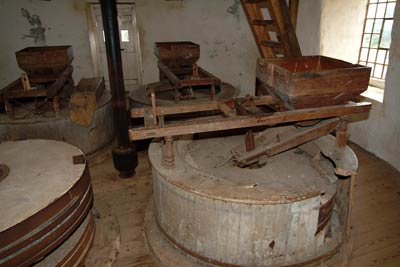
Stone tuns 4th June 2004 |
|
re Fire at Stalham_smock_mill:- |
The tallest windmill still standing in Britain is the nine storey Sutton Mill in Norfolk, built in 1853 which before being struck by lightning in 1941 had sails 73 ft. in diameter with 216 shutters. |
|
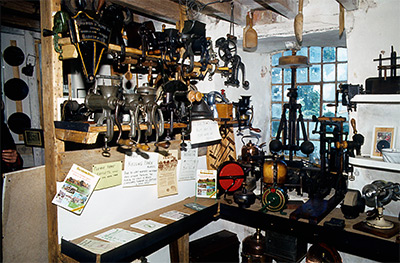
The mill was bought by Chris Nunn in 1975 and was restored to become a museum in its own right, quite apart from the Broads Museum housed in the surrounding complex. The Broads Museum housed an incredible collection of artifacts from a variety of trades and collections including old domestic utensils, kitchen appliances, woodworking tools, razors, leather trades, soaps & cleaners, trade tricycles, veterinary & animal instruments, traps, historical tobacco products, large engines, marsh & water implements, early cameras, TV's & radios and a complete Victorian pharmacy. |
Chris Nunn did much to restore the mill including the installation of new Honduran pine stocks. However by 2004, the mill was beginning to become dilapidated and was in need of a considerable amount of restoration work. |
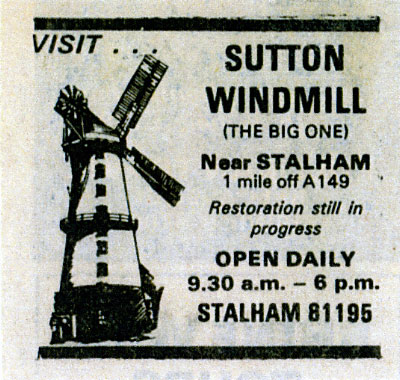 |
EDP advert 23rd July 1983 |
I went to Sutton mill in about 2004 and it was in a serious condition and there was quite a lot of problems. The staging was rotten and access was forbidden and there was a lot of rot in places. The cap leaked like a colander and if you wanted to access the fan-stage you had to use stairs created from 2 Workmates, several boxes and the windshaft itself and then the stage itself had a lot of rot and looked unsafe. |
 |
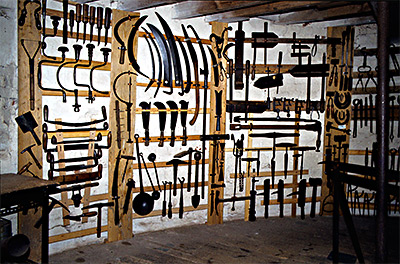 |
Kitchen apparatus in the Broads Museum - August 1982 |
Marshmen's tools in the Broads Museum - August 1982 |
 |
Victorian pharmacy in the Broads Museum 6th June 2004 |
Eastern Daily Press Wednesday 11th May 2005: Mill and museum advertised for sale as going concern |
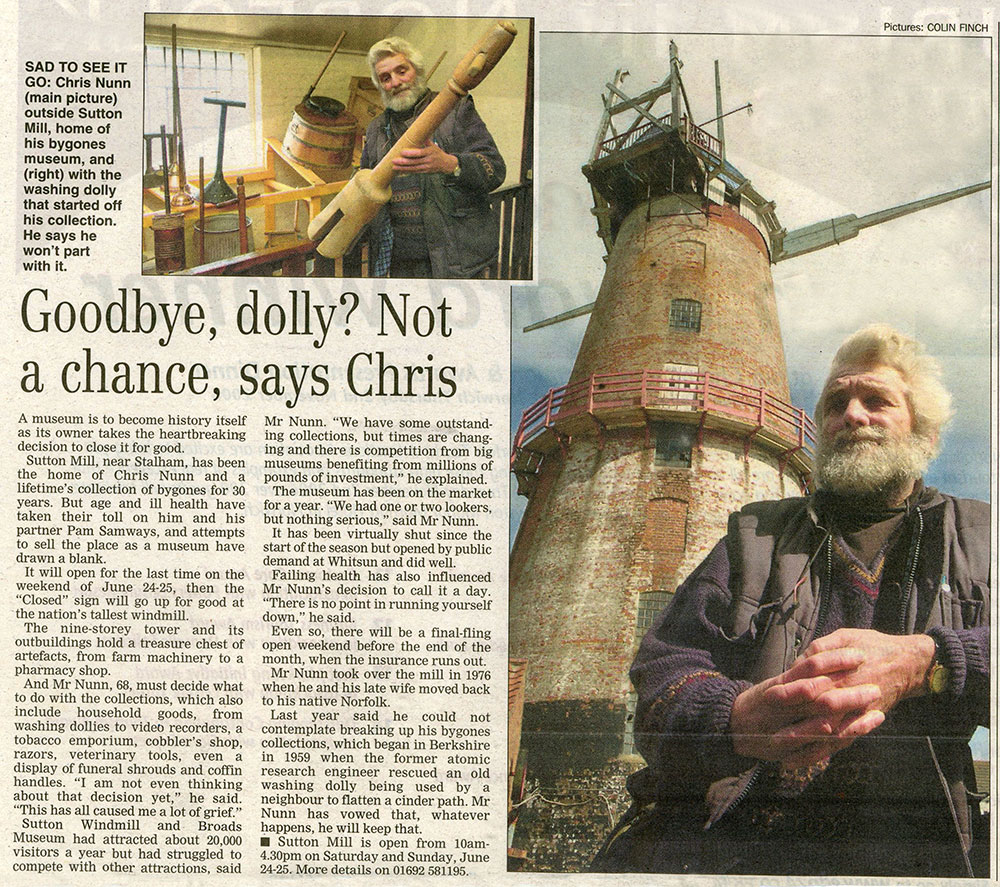 |
Eastern Daily Press - 12th June 2006 |
It is one of the tallest windmills
in the country and could be a
spectacular icon of the Broads, as it
was for many years.
Instead, Sutton Mill is looking
considerably the worse for wear and
there are no signs of it returning to a
good condition any time soon.
The grade II* listed mill near
Stalham is a key Norfolk building but
is on the county council’s Buildings
at Risk Register because it is deemed
to have been under-maintained for
years and is not watertight. The
upper floors are unsafe to enter, the
traditional Norfolk boat-shaped cap is
leaky and the sails are broken.
It hasn't been in use as a working
mill since 1940, when it was
producing animal feed having ceased |
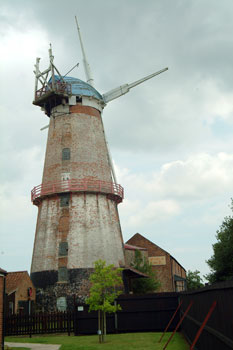 |
6th June 2004 |
In 2007 the upper floors of the Grade II listed mill were designated as being unsafe for visitors. Full restoration was estimated at requiring an investment of around £500,000. |
Yesterday's World Sutton Windmill and Broads Museum |
It is with regret that Yesterdays World have decided to close Sutton Windmill and Broads Museum permanently as from 26th September 2008. |
| Chunks of timber have been falling from the wooden cap of Grade II listed Sutton Mill, near Stalham, according to neighbour and parish council chairman Linda Matthews. North Norfolk District Council (NNDC) experts say the 79.5ft-tall mill is not a safety risk and the mill's owners warn they cannot afford the six-figure sum needed fully to restore the 18th-century mill - but both have pledged to work together in a bid to preserve an important piece of Norfolk's heritage. "It should be an asset to Sutton and Norfolk, but it's becoming an eyesore," said Ms Matthews, The nine-storey mill is on the county council's Buildings at Risk Register because of a lack of maintenance. Its upper floors are unsafe, it is not water-tight and the sails are broken. For 30 years, until 2006, it was visited by up to 20,000 people annually in its guise as The Sutton Windmill and Broads Museum, run by Chris Nunn and housing his huge collection of bygone artefacts. The mill now belongs to Yesterday's World, an East Sussex-based company which runs historical attractions, including one on Yarmouth's Marine Parade. Carl Partridge, chief executive of the Yesterday's World group, said they had tried to keep it open as a tourist attraction but it had become economically unviable. "Within the first month of opening it became quite clear why it wouldn't work," said Mr Partridge. It was off the tourist trail, poorly signed and down narrow roads, in an isolated rural area which was not designed to cope with large numbers of people. Yesterday's World, which closed the mill to the public in 2008, had realised that it would need at least £500,000 of restoration work. "Unfortunately we don't have half a million sitting in our pocket," said Mr Partridge. "And in my experience it wouldn't stop there. That would turn into £1m and then there would be the annual running costs." Yesterday's World recognised the importance of the mill and wanted to safeguard its future, he added. He was seeking talks with NNDC to try and find a solution which would both preserve and find a use for the building. But Jonathan Neville, of the Friends of Norfolk Mills, warned that the current economic climate meant public funding for such projects was drying up fast. "Its loss would be a great shame. It's a unique and iconic building which can be seen for miles around and we're very worried about it," said Mr Neville. Norfolk County Council will vote on Monday on a package of proposed cuts which would see the Norfolk Windmills Trust lose all of its annual £70,000 funding from 2012. The mill was "generally structurally sound", although the cap was in particular need of repair to make it wind and water tight, according to Chris Young, senior conservation and design officer with NNDC. Mr Young also said they would continue talking to the owners, and to English Heritage, in a bid to find answers. Alex Hurrell, Eastern Daily Press - Wednesday 9th February 2011 |
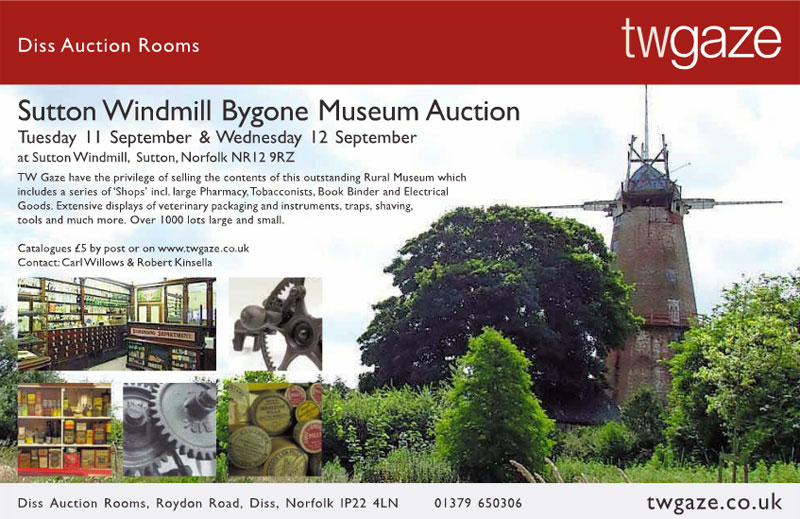 |
Eastern Daily Press - 8th September 2012 |
 |
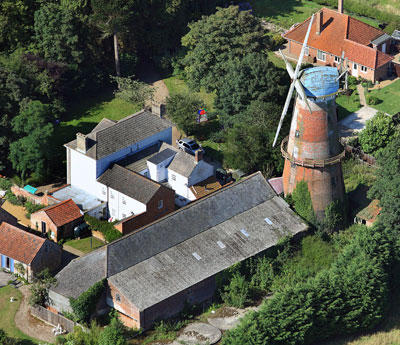 |
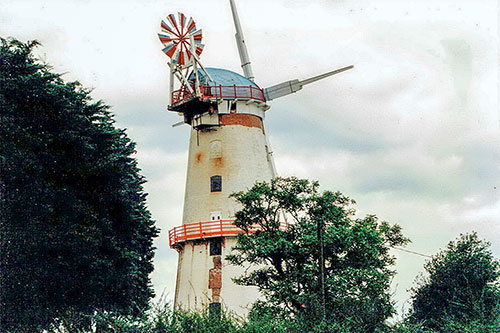
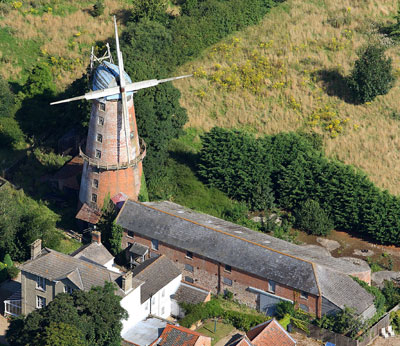
Mill complex with deteriorating mill cap 5th August 2014 |
|
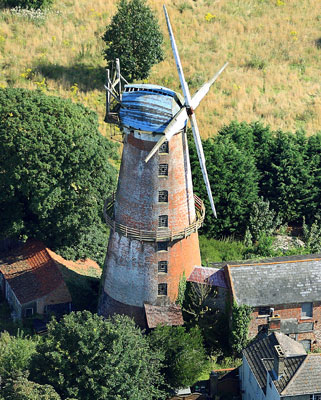 |
5th August 2014 |
Action team tackling eyesore buildings across north Norfolk |
Work is already being carried out to make crumbling Sutton Mill near Stalham, safe after chunks of timber fell from the cap after winter storms. |
Sutton Mill action |
Sutton Mill, which dates back to the 18th-century, has been empty since 2008 and the Grade 2 listed structure is on English Heritage’s buildings at risk register. The enforcement board stepped in after last winter’s storms caused sections of timber to fall from the 79.5ft-tall mill’s cap. Some chunks landed close to neighbouring properties. In January a section of the Weavers Way public footpath running beside the mill was diverted to protect walkers from possible injury.Council officers have used a warrant to get on to the site and assess it, then contacted the owners who had engaged the millwrights to advise NNDC, said council director Nick Baker. Minor safety works had been carried out and a timetable of work needing to be done was being drawn up. Mr Baker expected “significant improvement works to the capping and structure.”
The mill was bought in 2006 by the company Yesterday’s World which ran it as an historical attraction. But the firm closed it two years later, saying it was unviable. The News was unable to contact the owners. Alex Hurrell, EDP24 - Thursday 29th May 2014 |
 |
October 2014 |
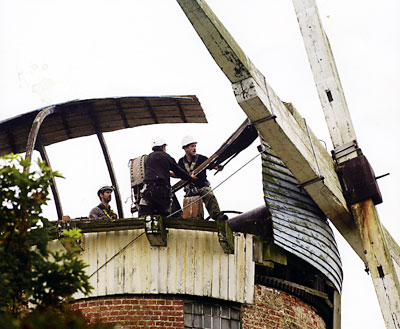
The mill built in 1789 originally had eight floors. When it was re-built after the fire of 1861 another floor was added to take it to its current height. During the past month the mill has had its stocks taken off along with the cap. New sails and cap will hopefully be made and refitted by the owners. To the surprise of locals, no attempt was made to retain the cap ribs, and fan carriage as patterns, which is likely to make restoration more difficult. Mill News - Mills Section of the Society for the Protection of Ancient Buildings - October 2014 |
Historic Norfolk mill could be safeguarded by
£350,000 council loan |
One of the tallest windmills in the UK, which is on the 'at risk' register, could be safeguarded by a £350,000 council loan. The North Norfolk District Council (NNDC) loan would allow ancient building experts to buy Sutton Mill, near Stalham. The loan was recommended for approval at the council's Cabinet meeting on Monday, December 4. A meeting of the Full Council will make the final decision. If agreed, the loan would be repaid over a period of eight years. The project to buy and refurbish the Grade II* Listed building, which was built in 1789, would also see a heritage centre established at the site, an academy for training millwrights and a workshop. Nigel Dixon, NNDC's cabinet member for economic development, said: "The project would safeguard an important heritage building on the Historic England 'at risk' register, ensure traditional skills are preserved and create a visitor centre in a part of the district with unrealised tourist potential. "It has the potential to act as a catalyst to help maintain and support the local tourism offer and small businesses. The economic benefits of this project should be felt in a number of sectors." The money is a key part of the funding jigsaw being put together by the mills section of the Society for the Protection of Ancient Buildings (SPAB). The National Millwrighting Centre CIC, a not for profit community interest company, has been set up to take it forward. The project would create the UK's National Academy for Traditional Milling and Millwrighting, which will train up to five professional and volunteer millwrights at any one time. A commercial millwrighting workshop would also be created to service the mills of East Anglia and beyond. The new heritage centre would include a commercial working windmill, holiday accommodation, an artisan bakery and artisan bakery school, a shop, café and workshops.Jonathan Cook, director of the CIC and chairman of the SPAB mills section, said: "Our vision for the project is to create a thriving, financially self-supporting training academy that secures the traditional craft skills required to repair, maintain and run traditional wind and watermills for the future." David Bale, Great Yarmouth Mercury - 4th December 2017 |
Could you help save on of the UK's tallest
windmills based in Norfolk? |
North Norfolk District Council is launching a crackdown on derelict buildings. A list of unsightly properties has been produced with owners being urged to make improvements or make a planning compulsory purchase on the property in question. Sutton Mill in Sutton near Stalham. A bid to save one of the UK's tallest windmills has been launched, with the aim of keeping the heritage site open for aspiring millers. The Sutton Mill is due to be sold next month, and a team hoping to create the National Milling and Millwriting Academy have launched a campaign to buy the property themselves. The National Milling and Millwriting Academy bid needs to raise £150,000 with the help from donors. A spokesperson for the academy said: "The National Milling and Millwrighting Academy based at the Sutton Mill Heritage Centre has been founded to safeguard the future of two traditional crafts which are as vital today as they were 150 years ago." The Grade II star listed windmill, which closed as a museum in 2008, is in need of renovation and comes with a granary of just over 7000 sqft and is set in approximately 1.85 acres. The museum previously welcomed around 20,000 visitors every year. Jon Cook is one of the directors of the Sutton Mill Project. He is urging bakeries to back the project so that traditional flour can still be provided. He said: "The future is bright for traditional stoneground milling today - more and more people are finding the benefits of local stoneground flour, whether milled in windmills and watermills or on-farm. "We can take advantage of the renaissance in artisan baking and traditional bakery methods and create fantastic jobs for millers." To back the project visit www.suttonmill.org.uk Eleanor Pringle, North Norfolk News - 17th March 2018 |
Campaign to buy Sutton Windmill fails after it sells to private buyer at online auction
|
Sutton Windmill, one of the tallest windmills in the UK, has sold to a private buyer dashing hopes of campaigners who were hoping to buy it to set up an academy. Sutton Mill has been sold by online auction to a private buyer, bringing to an end hopes of campaigners who were trying to buy the historic building to create a mill academy. The mill, which is the UK's tallest when it has its cap on, exchanged after it was bought by the highest bidder at online auction with Sowerbys. Members of the National Milling and Millwriting Academy posted a message on its website afterwards saying: "It is with the deepest regret that the directors of the National Millwrighting Centre CIC announce that we have failed to secure Sutton Mill to become the base for the National Milling and Millwrighting Academy. "Despite an overwhelming response to our pledge campaign from people nationally, but in particularly locally around Sutton, we were not able to secure the funds required to equal the bids made in the online auction for the site (the two lots - the bungalow and mill/granary)." The Grade II star listed windmill and granary in 1.85 acres went up for sale last month. The mill was in need of renovation including the restoration of the cap estimated to cost alone in the region of £100,000. It went up for sale with starting bids of £135,000 together with a four bedroom bungalow in three acres for starting bids of £250,000. Campaigners launched a major appeal to raise at least £150,000 to add to donations to create Sutton Windmill into an academy for the training of millwrights and millers. The windmill closed as a museum in 2008. Yesterday Jonathan Wood, head of the Norwich branch of Sowerbys, confirmed that contracts had exchanged on the mill which sold for in excess of the guide price, with the bungalow selling for £305,000 following 10 bids. Mr Wood said: "We at Sowerbys are delighted that Sutton Windmill has sold and that it will begin a new lease of life." Jonathan Cook, one of the directors of the campaign to buy it, said: "We are extremely disappointed that we weren't able to raise enough for Sutton windmill and we will be reviewing other potential sites." The official statement posted on the campaign site said: "The directors want to thank everyone who has dug deep to make pledges or donations to the project. We would also like to thank North Norfolk District Council and Sutton Parish Council for their unwavering support for the project, the Society for the Protection of Ancient Buildings (SPAB) and their Mills Section and our team of volunteers in Sutton and the surrounding villages who did everything within their power to engage the local community over recent months. "We can genuinely say 'we put our all' into trying to make this project a reality. "Any remaining funds left once the CIC's obligations have been met will be paid to the SPAB Mills Section in order that they can continue their work in setting up a Millwrighting Skills Programme." Caroline Culot, North Norfolk News - 16th April 2018 |
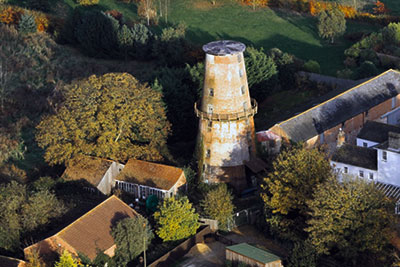 |
March 2018 |
Couple restoring 230-year-old windmill into family home
|
A couple have breathed new life into an historic Norfolk windmill and have their sights set on turning it into a family home. |
 |
15th October 2025 |
Towering Sutton Windmill in Norfolk on the market for £1.5m
|
A 230-year-old Norfolk windmill which has been restored and converted into a family home is on the market for £1.5m. |
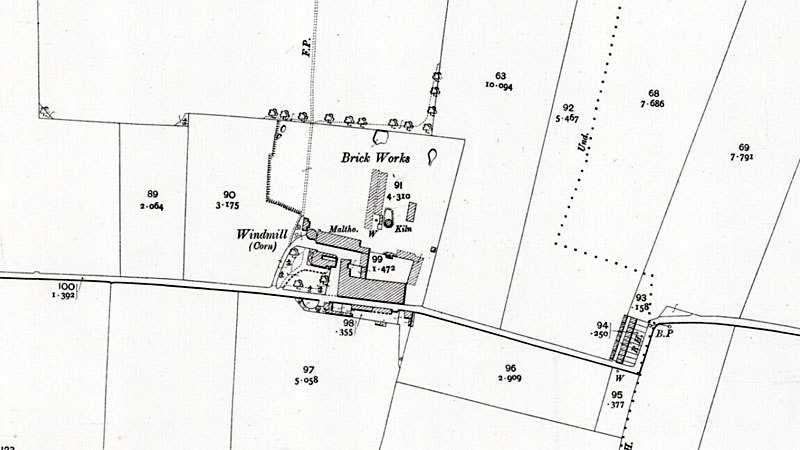 |
O. S. Map 1905 Courtesy of NLS map images |
1789: Mill built
White's 1845: John Bygrave jnr, miller & maltster 1845: John Bygrave jnr, miller, farmer, maltster & spirit merchant
White's 1854: Jonas Bygrave, victualler & brewer, windmill October 1857: Mill advertised to be let October 1858: Mill and farming stock of John Bygrave advertised for sale 1859: John Bygrave, miller & brewer
1861: Mill destroyed by fire and was later rebuilt by by millwrights, England of Ludham 1862: Mill rebuilt by millwrights, England of Ludham who replaced the common sails with patent sails White's 1864: Thomas Worts, corn miller & merchant 1875: J. Wort, miller 4th July 1875: Mill struck by lightning Kelly's 1879: Thomas Worts, miller & farmer
O.S. map 1884: Windmill Kelly's 1892: Thomas Worts, miller (wind), farmer, maltster, corn merchant & brick & tile maker, Sutton mill Kelly's 1896: Thomas Worts, miller (wind), farmer, maltster, corn merchant & brick & tile maker, Sutton mill Kelly's 1900: Thomas Worts, miller (wind), farmer, maltster, corn merchant & brick & tile maker, Sutton mill Kelly's 1904: Thomas Worts, miller (wind), farmer, maltster, corn merchant & brick & tile maker, Sutton mill Kelly's 1908: Thomas Worts, miller (wind), farmer, Sutton mill Kelly's 1912: Thomas Worts, miller (wind), Sutton mill 1915: Thomas Worts died at the age of 87 Kelly's 1916: Frank Worts, miller (wind), Sutton mill Kelly's 1922: Frank Worts, miller (wind), Sutton mill Kelly's 1925: Frank Worts, miller (wind), Sutton mill Kelly's 1929: Frank Worts, miller (wind) & corn dealer, Sutton mill. TN Stalham 4X2 Kelly's 1933: Frank Worts, miller (wind) & corn dealer, Sutton mill. TN Stalham 251 Kelly's 1937: Frank Worts, farmer, miller (wind) & corn dealer, Sutton mill. TN Stalham 251 (over 150 acres) Karl Wood painting 1937: Mill shown to be in working order 1939: Mill working 1940: Mill struck by lightning, damaging the sails and causing a fire. Commercial operation then ceased 16th April 1955: Mill designated with a Grade ll listing O.S. map 1974: Windmill 1975: Mill bought from Worts family by Chris Nunn and restored to become part of the Broads Museum Guinness Book of Records 1982: Sutton Mill recorded as tallest mill still standing in Britain 11th May 2005: Mill and museum advertised for sale as going concern October 2006: Mill bought by Yesterday's World - Les & Tara Haines, managers 26th September 2008: Mill and Broads Museum closed for business Saturday 8th September 2012: Bygone Museum contents advertised for sale by auction by T.W. Gaze May 2014: Work being carried out to make cap safer as wood had been falling from it September 2014: Cap removed and temporary ? flat roof installed 4th October 2017: National Millwrighting Centre CIC acquires mill subject to contract December 2017: Loan from NNDC committee for National Millwrighting Centre to buy mill approved December 2017: Various funding campaigns being organised by the new website April 2018: Mill sold to Kyle Smart & Lisa Smith in Sowerby's online auction August 2018: Restoration in progress February 2021: Planning application to convert the mill complex to residential & holiday let accommodation May 2021: New cap and fantail installed September 2022: Mill complex advertised for sale by Minors & Brady for £1,000,000 - £1,200,000 June 2023: Mill complex advertised for sale by Rightmove for £1,900,000 September 2023: Mill complex advertised for sale by By Design for £1,750,000 May 2024: New stocks fitted October 2025: Mill complex advertised for sale by By Design for reduced price of £1,450,000 August 2026: Mill complex advertised for sale by By Design for reduced price of £1,500,000 |
If you have any memories, anecdotes or photos please let us know and we may be able to use them to update the site. By all means telephone 07836 675369 or email |
| Nat Grid Ref TG 39572387 |
Copyright © Jonathan Neville 2004 |