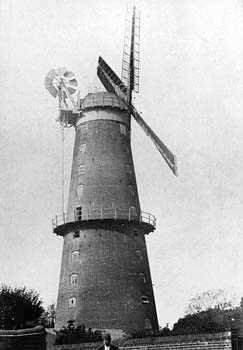
c.1890
|
Gt. Yarmouth Southtown
High Mill towermill |
|
|
c.1890
|
|
Gt Yarmouth
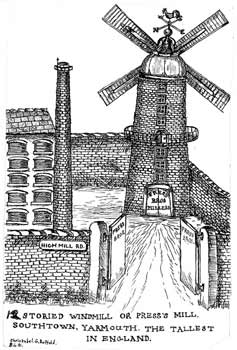
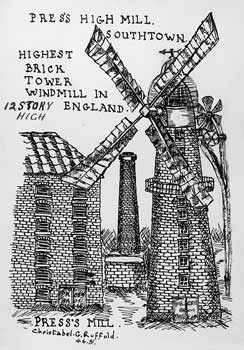
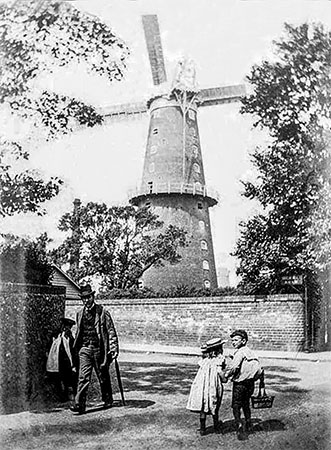
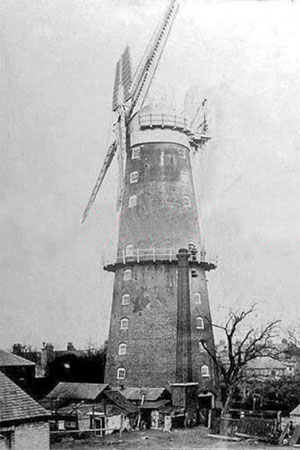
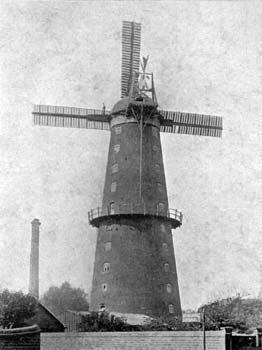
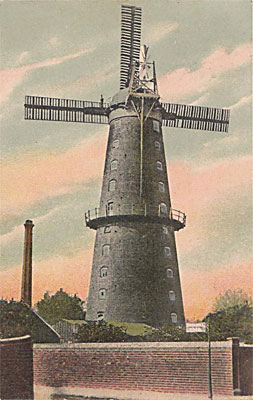
Southtown tower mill, which was often known as High Mill or Press's Mill was 122
feet to the top of the 20 foot lantern and was one of the tallest windmills ever built in
Europe, extending to 12 storeys including the ogee cap. The lantern was installed to act as a lighthouse. At ground level, the base of
the mill had an outside diameter of 40 feet (also reported at 46 feet) with walls 3 feet thick and it was said that carts could drive into the mill to load up inside the tower. |
The mill had 4 double shuttered patent sails with an 84 foot span and 10 bays of 3 shutters that drove 4 pairs of stones on the 7th floor, 3 flour mills and 2 jumpers. The ogee cap had a gallery and held an 8 bladed fantail with a chainpole and the stage was on the 6th floor. The windshaft was reported to have weighed 5 tons and when combined with the cap, gallery and fantail the weight was said to have totaled 15 tons. |
The 4 pairs of stones ground 9 coombs of wheat or 20 coombs of oats per hour. |
YARMOUTH - SMALL COLLECTIONS
Class No. D 32/1 SOUTHTOWN MILLS Judgment in BROWN, D. D. v WOOLLSEY and others re payment of tithes on mills at Southtown and Counsel's opinion re same. 1826 Court of Exchequer Tuesday 7 February 1826 Lord Chief Baron - Tithe cause, Plaintiff Rector of South Town against defendants for an account of the Tithes of Mills in their occupation. Defendant WATERS - mill built within 50 years on the site of an old mill and is therefore an ancient mill - no support for this, therefore all recent mills. Defendants say they do not grind for hire in the usual way, but they are Corn and Grain merchants, that they buy the corn and grain, grind it and then sell the Flour in its manufactured state and they insist that for this operation no tithe is payable. Case dismissed as Defendants business regarded as a Trade on which no tithe was payable. Difficult to separate small amount of grist or Bag Work (for which tithe might be payable on the profits) from their main business as Corn Merchants. Counsel's opinion - Disagreed with judgment, might be a case for appeal, but costs would greatly exceed amount of tithe involved. |
|
----------------------- |
|
| Defendants - | John WOOLLSEY of High Mill James JENNER of Green Cap Mill Robert WATERS of Cobholm Mill |
In 1825 Dr. Browne as Rector of Southtown and Vicar of Gorleston took legal proceedings against Woollsey and others to compel payments of tithes on their mills. The defendants contended that they were merchants purchasing corn, grinding it and selling the flour and not grinding other people's grain for profit, as was generally the case with ancient mills, which it was admitted, were titheable. When the case came before the Barons of the Exchequer, they by a majority, dismissed the Bill, but without costs. Dr. Browne then applied to the clergy in general for funds to carry the cause to the House of Lords, but receiving no response, the matter dropped.
The Perlustration of Great Yarmouth, Charles John Palmer - 1875 |
John WOOLLSEY & John SECKER
Late Wine & Spirit Merchants Commission of Bankrupt dated 13 May 1831 Norfolk Chronicle - 11th June 1831 & 10th November 1832 |
WOOLLSEY & SECKER's Bankruptcy
Notice is hereby given to all persons who are indebted to the Estate of the said Bankrupts to pay the amount of their respective Debts with one month from the date hereof to Mr. Thomas_HAMMOND the younger of Great Yarmouth, Miller, one of the Assignees, otherwise legal means will be taken to enforce the payment thereof. Dated this 4th day of August 1831. Norfolk Chronicle - 6th August 1831 |
To be Sold by Auction under a Commission of Bankrupt against John WOOLLSEY & John SECKER, of Great Yarmouth, wine & spirit merchants, dealers & chapmen, and on the application of the Mortgagees, at the Bear Inn, Bridge Foot, Great Yarmouth, on 8 September.
Lot 1. . . . the 11 floor mill at Southtown . . . London Gazette - 16th August 1831 |
To MERCHANTS, MILLERS, and CAPITALISTS |
To be Premptorily SOLD by AUCTION |
Pursuant to Certain Orders of the Commissioners under a Commission of Bankrupt awarded and issued against JOHN WOOLSEY & JOHN SECKER of Great Yarmouth in the county of Norfolk, Wine & Spirit Merchants, Dealers & Chapmen and on the application of the Mortgagees the following ESTATES at the respective places aforementioned. At the Bear Inn Bridge Foot, Great Yarmouth, on Thursday 8th September next at 11 o'c, by WALTER C. PETTINGILL Lot 1. All the capital new built WINDMILL situate in Southtown next Great Yarmouth, having a Brick Tower containing eleven floors, the lowest being 34 feet diameter, working four pair of stones, three flour mills and two jumpers, capable of manufacturing upon an average 120 quarters of wheat per week; also a convenient new built Dwelling house with stable, suitable offices and two acres of capital pasture land situate in Southtown aforesaid where the parochial charges are trifling and within 200 yards of Yarmouth Bridge and the Corn Market. The Mill is in full trade with good country and town connections. The above Estate is Leasehold for a term of 80 years of which 61 will be unexpired at Christmas next and is subject only to an annual rent of £20. Lot 2. All the capital Freehold Messuage with shop . . . And also at the King's Arms Inn, North Walsham On the aforesaid 8th day of September, at Six o'clock in the Evening, Lot 3. All that capital Dwelling-house, with convenient outbuildings, yard and garden, together with the Water-mill, Cottage, and Granaries adjoining, and about 16 acres of Arable and Meadow Land of the best quality, in the highest state of cultivation. And also a Wind-mill and about two roods and 30 perches of Arable Land. The above Premises are situate in Swafield and North Walsham, and are in full trade, and now in the occupation of Mr. Benjamin Postle Woollsey, as tenant from year to year. The Water_Mill, Cottage, Granaries, and about nine acres of the Land are Leasehold of the Bishop of Norwich, for a term of 21 years, commencing the 10th October, 1827, at an annual rent of 3l. 13s. 4d. The Mill commands a good head of water, and drives two pair of stones and two flour mills. The Dwelling-house, Out-buildings, Yard and Garden, and about five acres, three roods, and 22 perches of the Land are Freehold and pleasantly situated. The Wind-mill, which is in excellent repair, and two roods and 30 perches of Land are Copy-hold of the Manor of North Walsham about half a mile. This Estate offers either a desirable Investment for Money, or a good situation for an active Man of Business, having water carriage to the Port of Yarmouth, is within 16 miles of Norwich, one of North Walsham, and 26 of Yarmouth. And at the same time and place last mentioned, will be Sold by order of the Assignees of the said Bankrupt. A Place of Freehold Arable Land, situate in Swafield, near Swafield Bridge, leading over the North Walsham and Dilham Canal, containing about one acre and one rood, and is well calculated for Warehouses, Granaries, Coal and Timber Yards - Also one Share in the North Walsham and Dilham Canal. Further particulars may be had in London of Messrs. Amory and Coles, Solicitors, Throgmorton Street; Messrs. Swaine and C. Solicitors, Frederick's Place, Old Jewry; Mr. Lythgoe, Essex Street, Strand; and in the County, of Mr. Clowes, and Messrs. Sayers and Glasspool, Solicitors, Great Yarmouth. Norfolk Chronicle - 13th, 20th & 27th August 1831 |
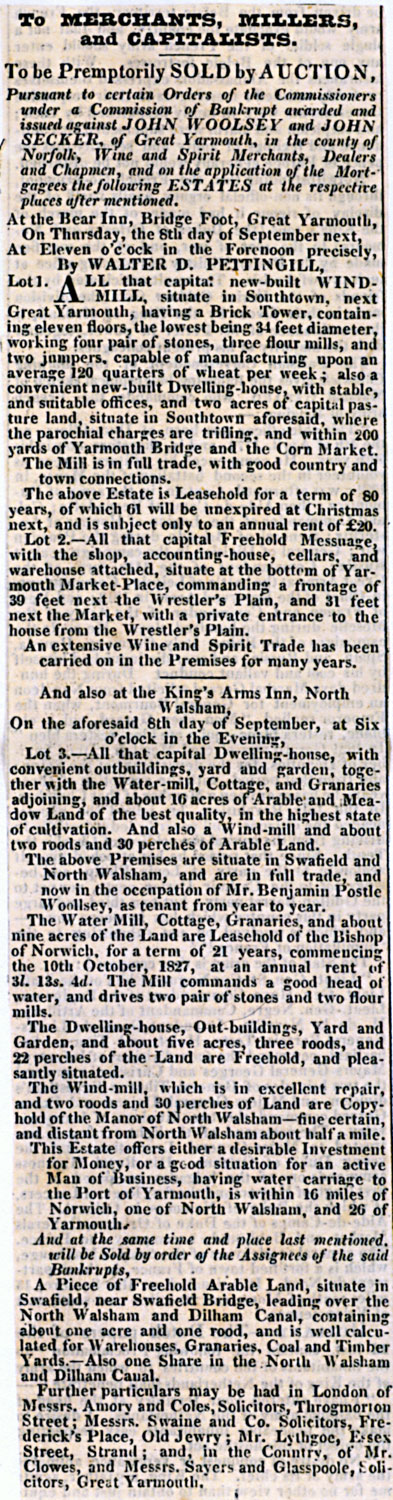 |
Norfolk Chronicle - 13th, 20th & 27th August 1831 |
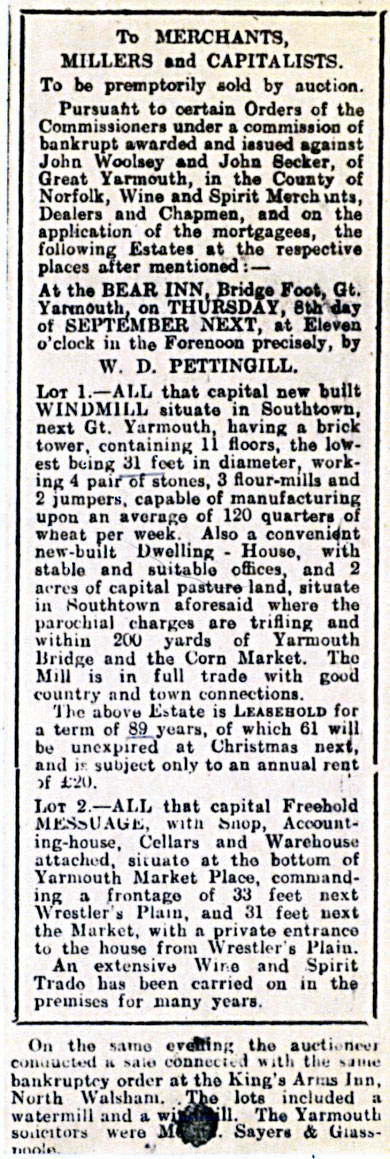 |
Yarmouth Windmill, H. B. Johnson, Mercury - 1831 |
WOOLLSEY & SECKER's Bankruptcy
Notice is hereby given to all persons who are indebted to the Estate of the said Bankrupts to pay the amount of their respective Debts to Mr. Thomas_HAMMOND of Great Yarmouth, Miller, one of the Assignees within ten days from the date hereof and that unless the same are severally discharges accordingly proceedings will be commenced without further notice. Great Yarmouth, 15 March 1832. Norfolk Chronicle - 17th March 1832 |
WOOLLSEY & SECKER's BANKRUPTCY
The creditors who have proved their debts and substantiated their claims under the above mentioned Bankruptcy may receive a Dividend upon their respective debts under the Joint Estate of the said Bankrupts and the separate Estate of John WOOLLSEY upon application at the Bank of Messrs. GURNEYS, TURNER & BRIGHTWEN, Bankers, Great Yarmouth. By Order of the Assignees Great Yarmouth, 15 March 1832. |
Thos. CLOWES |
| Norfolk Chronicle - 17th March 1832 |
 |
|
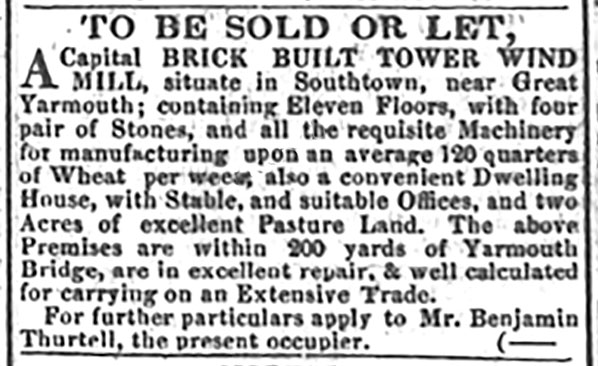
Norwich Mercury - 13th September 1834 |
An Old Established CORN MILL
To be Sold by Auction by Pettingill at the Star Hotel, Great Yarmouth on Wednesday, 6 July 1842 at 12 o'c noon. A Capital BRICK TOWER WINDMILL with Respectable RESIDENCE, Gardens, Malthouse, Cottages etc. In Southtown, Suffolk. Lot 1. All that excellent WINDMILL situate in Southtown next Great Yarmouth under Lease to Mr. Branford which expires at Michaelmas next, having a Brick Tower containing eleven floors, the lowest thirty four diameter and capable of manufacturing upon an average 120 quarters of wheat per week; a convenient Dwelling House with suitable offices, Stables, Gig and Harness house, Cart lodge, Cow house, Pig cotes etc., well planted Gardens and Pasture Land about 2 acres. The above Premises are well establishes for trade and are about 200 yards from Yarmouth Bridge, near the Corn Market and eligibly situated for doing an extensive Business. The parochial charges are trifling. The above Estate is Leasehold for a term of 80 years of which 51 were unexpired at Christmas last and is subject to an Annual Ground Rent of £20. Lot 2. A Malt House known as "Matsell's Malting" of 30 coombs Steep with Yard, and cottage adjoining situate near Lot 1. Unoccupied. The above Estate is Leasehold for a term of 80 years of which 44 were unexpired at Christmas last and subject only to an apportioned Ground Rent of £2. 10s. Apply to the Auctioneer or to Messrs. Clowes & Son, Solrs. Yarmouth. Norfolk Chronicle - 25th June & 2nd July 1842 |
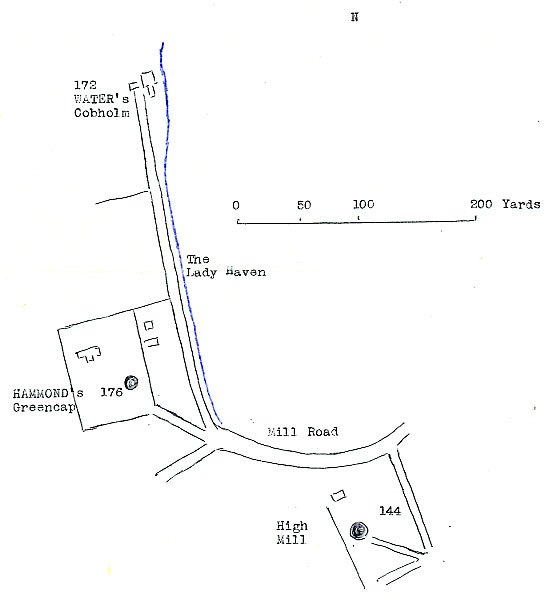 |
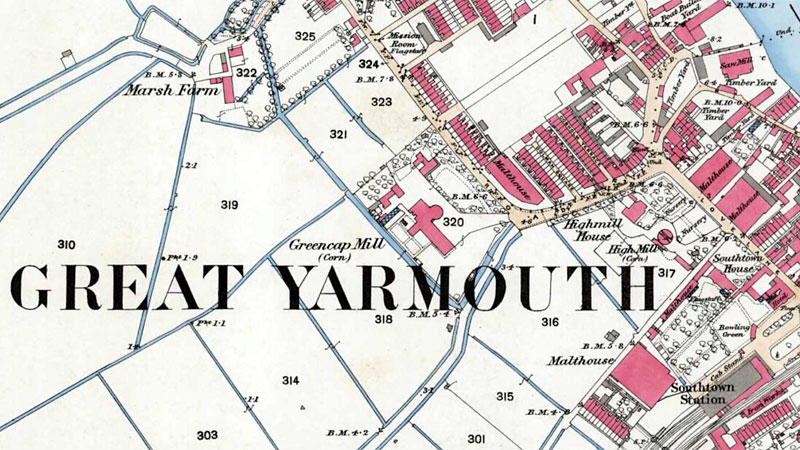
Tithe map of 1843 as redrawn by Harry Apling |
c.1845 a steam engine to drive an additional 3 pairs of stones was installed. |
Southtown. Title Deeds of the Press Family Property.
Two acres west of road to Cobholm and south of road to Back Marshes in 1812 leased for term of 80 years by George Anson's trustees to John Woolsey and where in 1812/13 Woollsey had erected a brick tower windmill (later known as High Mill, and a messuage valued at £2000. Lease assigned to BIRKBECK, STAFFORD & RODGERS. Property conveyed in 1881 by Stephen John Frederick Stafford to Edward and Benjamin Howard Press. Also documents re bankruptcy of John Woollsey and John Secker in 1831 and repairs of 1870 to steam machinery Brick built windmill eleven floors high driving four pairs of stones with boiler house, dwelling house etc. Piece of accommodation marsh next same, sold in 1883 by the Earl of Lichfield and Viscount Anson to Edward and Benjamin Howard Press. Lucas & Wyllys, Yarmouth Records, Norfolk Record Office |
In 1831 the grinding capacity of the 4 pairs of stones was recorded as: |
Tithe Award 1849 |
||||
No. 144 |
House, Mill & Premises |
Pasture |
1a. 1r. 21p. |
6s 6d |
It would appear that |
 |
 |
Sketch c.1890 |
Sketch c.1890 |
 |
|
c.1890 |
St. Ann's Foundry, King Street, Norwich, June 28th 1853 |
Mr. H. Gambling, Sir, Having examined the High Mill, Southdown, I beg to say I will undertake to execute the following repairs. viz. 1 new clamp to Stock 34ft long 12"x12". To take down the 4 sails and repair do. with new canvas to vanes, new screws & sail irons where necessary, to ease the neck brass, to make a new tail brass, to find new cogs and gear the wheel to drive the flourmills, with the cogs now in the Mill, one wood rigger to do. - to find cogs and gear 2 stone nuts, and repr. 2 pr. universal joints to flourmills with Men's time at Mill taking down and refixing sails &c. in a workmanlike manner will amt. to the sum of Sixty Four Pounds five shillings. £64.5.0 |
| I am, Sir, £64. 5. 0. Your Obedt. & Hble. Servt. for Thos. Smithdale, John G. Buttifant |
9-7-1853 |
Mr. Gambling, Yarmouth |
||
cost |
with profit |
||
£. s. d. |
£. s. d. |
||
| 2 14" files |
4.3. |
||
| King. 6 days | 1.8.0. |
1.13.0. |
|
| Brister. 5¾ do. | 1. 3.11½ |
1. 8. 9. |
|
| Labourer. 5 do. | 12. 6. |
15. 0. |
|
| 16-7. | King. 6 days | 1. 8. 0. |
1.13. 0. |
| Brister. 6¼ do. | 1. 6. ½ |
1.11. 3. |
|
| Carrow. 5½ do. Labourer. 3 do. John G. B. ¾ do. |
1. 0. 2. 7. 6. 3. 1½ |
1. 7. 6. 9. 0. 3. 9. |
|
|
Train, J.G.B. and Men H.C. & Brister, Lodgings J.G.B. 2¼ days Patterns 3 maces & 3 rings Sawing clamp 1 Gross 2in. screws 1 do. 1½in. do 50 cogs S. wheel 13 Yards Canvas for Vanes 21ft. Appletree 2.in for Stone nut cogs Time cutting do. Gowen. ¾ day Gearing 1 Step 12½ lbs. 4 Brasses Jumper. 3lbs. Iron for crotches 9lbs. Time at Mill Do. shop. Do. Do. Do. Do. Do. at Mill. Do. at Shop. Do. Mill. 22 yds. Canvass Railway Expences and Journeys |
5. 0.)_ 4. 0.) 7.10½ 7.10½ 7. 4. 2.10. 1. 6. 11. 2½ 9. 2½ 7. 0. 8. 0. 3. 0. 7.15. 6. 1.11. 3. 6. 6. 19.10½ 5.19. 9½ 10. 2. 8. 3. 1. 15. 7. 2.0.0. |
9. 0. 10. 1½ 15. 9. 7. 4. 4. 6. 3. 6. 10.10½ 10. 3½ 10. 6. 3. 4½ 3. 4½ 14. 7. 4. 6. 4. 6. 9. 6. 0. 1.18. 3. 8. 6. 1. 6. 3. 7. 5. 6. 13. 6. 9.18. 9. 17. 5. 2.0.0. |
The mill worked both day and night; a double shift of four men each was worked. In 1854 during the Crimean War, the mill came into national prominence when its flour was supplied to Lord Raglan's army and shipped by a number of Yarmouth's famous clipper schooners, chartered to race to the Black Sea ports. |
Accident – On Wednesday afternoon Mr Holmes, an engineer belonging to Norwich, while superintending some alterations at the High-mill, Southtown, by some means entangled his left hand in the machinery, and received very severe injuries. Norfolk Chronicle - 24th August 1861 |
Parish of Gorleston with the Hamlet of Southtown in the Counties of Suffolk & Norfolk
|
|||
| POOR RATE 1870 |
Made 11 May 1870 at 4d in the £ | ||
| Occupier: Parker, William Owner: do |
|||
House, Mill & Land, Mill Road, 2a. 2r. 9p Gross Estimated Rental Rateable Value |
£135 £90 |
||
3 months Poor Rate |
£ 1. 10s. | ||
J. W. DE CAUX has received instructions from the Mortgagees to Sell by Auction without reserve on Wednesday July 27, 1870 at 4 o'c in the afternoon at the Star Hotel, Great Yarmouth in One Lot including Fixtures, all that spacious and commodious Brick Tower Wind & Steam MILL situate in Southtown, next Great Yarmouth with the Dwelling House and Outbuildings and 2 acres of Garden Ground and Pasture Land attached. |
J. W. DE CAUX has received instructions from the Mortgagees to Sell by Auction without reserve on Thursday September 15, 1870 at 6 for 7 o'c in the evening at the Star Hotel, Great Yarmouth in One Lot including Fixtures, all that spacious and commodious Brick Tower Wind & Steam MILL situate in Southtown, next Great Yarmouth with the Dwelling House and Outbuildings and 2 acres of Garden Ground and Pasture Land attached. |
On the north side of the Southtown Road after passing over the bridge . . . The first road through is called SAW MILL LANE because it leads to a Steam Saw Mill erected by Messrs. SAUL. Here also is a Steam Flour Mill belonging to Messrs. GAMBLING. The next to the right at the turn of the road is called MILL ROAD because on the west side of it stands a Tower Windmill, erected in 1813 by Mr. Woollsey. It is 120 feet in height to the top of the cap, has eleven stories and is capable of manufacturing 200 quarters of grain weekly . . . |
 |
 |
Yarmouth Gazette - 20th November 1886 |
Norfolk News - November 1886 |
 |
|
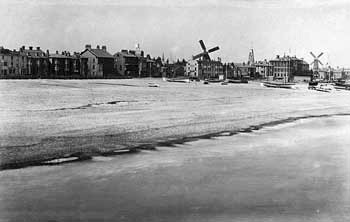
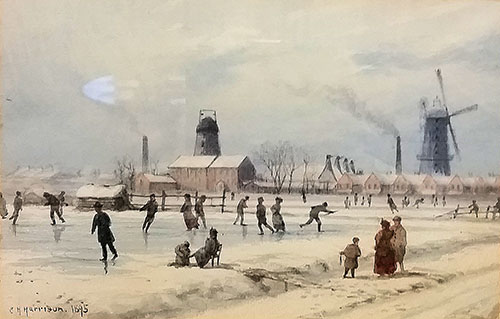
Halfway House towermill (almost certainly) in foreground and High Mill in distance
Painting - Skating and mills, Gt Yarmouth .Charles Harmony Harrison - 1895 |
 |
 |
|
c.1895 |
c.1896 |
 |
1901 |
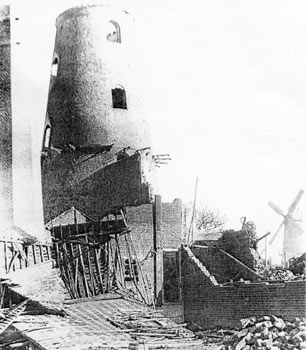 |
Remains of Greencap Mill after the fire in foreground with High Mill in the distance - 1898 |
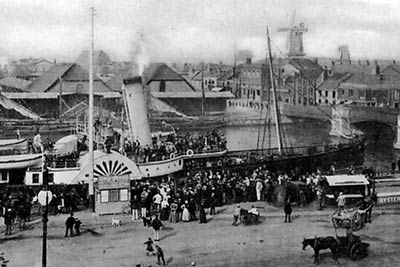 |
Port scene near Haven Bridge c.1900 |
 |
 |
|
c.1897 |
|
 |
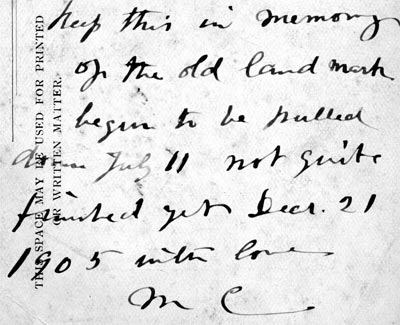 |
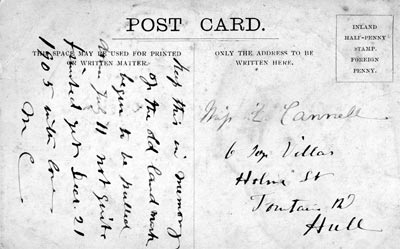
1905 postcard and closeup of message detailing destruction of the mill (reverse of card featured the b&w photo above) |
|
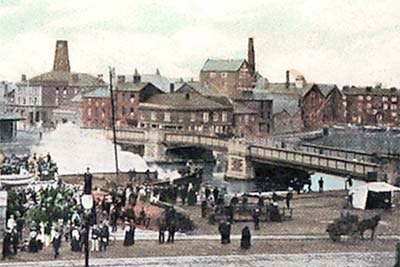 |
Port scene near Haven Bridge postmarked 13th September 1906 |
By MADDISON, MILES & MADDISON |
|
When the mill was demolished in 1904, the estimated 300,000 bricks were used to build a whole row of terraced houses. The spot where the mill stood was then occupied by nos. 35 & 36, High Mill Terrace, Gatacre Road and is indicated by those two houses having red chimney pots, the others being of stone colour. The sails were taken to Roughton_Mill_Hill_towermill as that mill was also owned by the Press family. |
At Southtown the noted High Mill of Press Bros. stood north of Love Lane, after Jas. Love, the blacksmith. Nos. 36 & 37 Gatacre Road are probably the centre of the High Mill site. |
Branford the miller had the High Mill in 1842. The firm became Branford & Palmer shortly after when the steam mill was added. In the '60s William Parker was owner and I believe the Press family were in possession before before 1870. Work ceased at this mill in 1898 . . . it was announced as for auction on August 24th 1904 following the death of Benjamin Howard Press (Mayor 1899). It was sold to W. W. Willimont for £100 at the Star Hotel by Mr. J. C. Miles and Gatacre Road off High Mill Road was made upon its site. |
A Famous Windmill |
Mr. A. J. Thrower, Great Yarmouth Millwright who worked on the High Mill (Southtown, Yarmouth) etc. told me in 1951, "The Sails from the High Mill were fitted to Roughton_Mill, so she must have been very powerful." |
Rex Wailes reported that the 4 ft. wheat stones were sent to Saxtead Green in Suffolk. |
As a child in the 1950’s I was often shown the post card of the High Mill and told that the man standing on the cross arm was my grandfather, Robert Albert Cook, who eventually moved in to No.2 Gatacre Road which was reputedly with from bricks reclaimed from the demolition of the mill in 1905. |
I am amazed at your website and just sent links to a fellow in Australia who is a descendant of the Presses. |
 |
1812: Mill built for Thomas Woolsey for £10,000 driving 4 pairs of stones |
If you have any memories, anecdotes or photos please let us know and we may be able to use them to update the site. By all means telephone 07836 675369 or
|
| Nat Grid Ref TG 51880745 |
Copyright © Jonathan Neville 2004 |