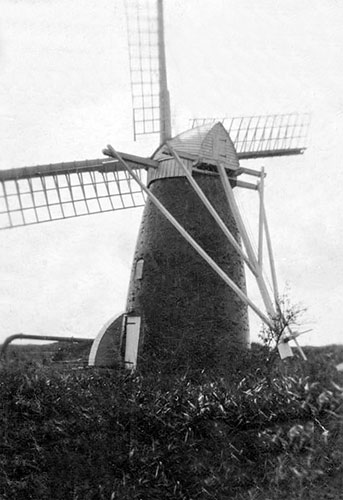
May 1933
|
Belton Black Mill drainage pump River Waveney |
|
|
May 1933 |
|
Belton Black mill was built as a 3 storey red brick tower windpump with a Norfolk boat shaped cap and skirt, using common sails turned to wind via a tailpole to power a scoopwheel. |
 |
16th May 1989 |
|
By the 1980s a modern pump had been set up inside the tower and on the outside of the tower a cast iron case was inscribed Thos. Smithdale & Sons Engineers Acle Norfolk AD1973. |
 |
August 2023 |
I have written about my father's life and memories of Belton marshes and the Black Mill. |
Among the Reeds and Marshes - A Memoir |
When I look back on my childhood, I remember the marshes around Belton as a place of water,
reeds, cattle and open skies. It was a working landscape, and my father was very much a part
of it. After getting married, my father became a marshman, looking after Belton marshes and
the cattle that grazed them. He also worked the Black Mill, which was used to drain the
marshes. The mill was an important part of life on the marsh. When my father first worked
there it still had sails, turning in the wind, although later it was converted to diesel. We lived in a tenanted farmhouse on the edge of Belton marshes. During the winter my father was not wanted on the marshes, so he turned to cutting reeds for thatching. He would cut reeds along about three miles of the River Waveney. In those days all the drains were dug by hand and the dykes had to be kept clear. Tools such as a Shore Cutter, a Meg and a Crome were used for the work. As a boy, I spent many hours helping my father clean the dykes. I didn't think of it as anything special at the time; it was simply part of life. I loved working at the mill, and I also enjoyed being out on the marshes. There was always something to see and hear - the wind moving through the reeds, water in the dykes, cattle grazing and the river slowly making its way through the marsh. Herons rose and dived, coots and moorhens scuttered across the water, swans sailed gracefully by. Hundreds of pink footed geese arrived in late autumn. Their honking became such a familiar and comforting sound during the desolate days of winter. I especially liked the cormorants with their outstretched wings drying in the wind. I often wished I could dry as quickly as they. One soaking from the relentless hammering rain, meant I stayed wet all day. The one animal I didn’t like though was the coypu. It was introduced in the early 1920’s for its fur. It was a terrible mistake as it caused immense damage to the reeds and riverbanks. During the winter months, from December to March, I worked with my father and his brother George cutting reeds. George had lost his wife to tuberculosis when she was only thirty-two. He never re-married. Reed cutting was often bitterly cold, wet and always hard work. I suffered with chilblains and if I complained I was cold my father would tell me I wasn't working hard enough; ‘Dew yew work a bit harder then bor,’ he would say. He and my uncle George would often break the ice on those bitter cold days to wash their bare hands. The cold never seemed to bother them as it did me. They were the toughened manual labourers of a long past era. For many years the reeds were cut by hand with a scythe. Later an Allen motor scythe was used, followed by a much better Mayfield motor scythe. Once the reeds had been cut, they had to be moved. Some were carried to the River Waveney and loaded onto Wherries, while others were taken to the marsh side and loaded onto lorries. I normally helped load the lorries for the drivers. The loads were built high and needed a slight camber so that they would sit properly for the journey along the roads. The reeds we cut on the marshes travelled a long way. They were sold to several buyers and sent to different parts of the country, even as far away as the Isle of Wight. I remember one particularly fateful day when, after we had finished work for the day, my father told me to burn some rubbish that had floated up the river on a high tide. I watched in horror as the fire, which was meant to burn the rubbish, quickly spread to the stack of reeds we had spent the entire day cutting. Although, there was a river full of water beside us, we didn’t have anything in which to carry enough water to put out the fire. And so, that terrible day, we walked the two miles home as empty-handed as we had walked the two miles to work that morning. Looking back, I realise how closely our lives were connected with the marsh. The seasons dictated the work, the water had to be controlled, the cattle depended on the grazing and the reeds that grew beside the river provided a living for the people who cut them. It was hard work, but there was also a great beauty in those marshes. I can still picture the reeds moving in the wind, the open fields, the water-filled dykes and the River Waveney running through it all. During mid-winter the water often froze on the marsh, creating large, shallow pools of water which my friends and I would skate on. I became a good skater during my teenage years. I never skated on the river though; I was all too aware of the dangers of doing that. Then came the terrible North Sea flood of 1953. On that night my father had gone to the pictures in Gt. Yarmouth. During the evening, a message flashed on the screen telling everyone who lived on the other side of the River Yare to leave immediately if they wished to cross the bridge. When my father got to the bridge, the water was already flowing over the edges and into town. He waded through anyway, although this was later stopped by the police, and caught a train out of Southtown Railway Station for Belton. On arriving home, he said that, as the train left the station, railway sleepers were floating about in the station yard and the train was moving slowly through the water. My father warned us of the danger of a large tide and said that if the bank protecting us from the River Waveney broke our house would be flooded, as we lived on the edge of the marsh. As a precaution, I took a loaf of bread along with a knife and placed them on my bedside cabinet. I have always been able to sleep through anything and must have done that night. I recall looking out of the upstairs window in the morning and seeing water like an inland sea. Fortunately, it had stopped within about 30 yards of our house. On going down and looking at the water's edge, hundreds of dead fish had floated up, killed by the salt water. I walked with my father to see the river walls, but he considered it too dangerous to go along the wall, as the water had come over it and washed the bank away in many places. The banks had to be repaired first before the mills could start pumping the water off the marshes. Hundreds of volunteers, my father and myself included, spent many hours in those freezing February days shoring up the banks and plugging the gaps in the walls. Only then could the mills have a chance of clearing the water from the marshes. After a few days, the river returned to normal and my father started the diesel engine in the mill pumping. At first, this meant a long walk around the walls to get there, as the water on the marshes was too deep to cross. Forty-gallon drums of diesel were brought up by Wherry, as this was the only way to get to the mill. The water slowly came down to a depth that could be waded through So, keeping to the high places, the mill could be reached by a more direct route across the marshes. I waded through the murky water for about three-quarters of a mile many times at night, shining a torch through the darkness, so to relieve my father from the mill. The engine had to be kept full of diesel at all cost. In addition to the mill, sluices were used at first to push water out into the river. Finding them was not easy, as the last one had not been used for probably a hundred years. This meant wading into the water with a spade on the flooded side. Once found, the door then had to be dug out and opened. My father did this. I would like to say that the old oak doors worked perfectly well. However, as the marshes had dried and settled over the years, the doors were in fact well above the present level of the marshes and were therefore of limited use. After some two or three weeks, the water was eventually pumped off the marshes. The mill engine, which had not stopped except for engine-oil changes, was in a bad way and was eventually replaced. On that dreadful night of January 31st, 1953, 307 people lost their lives along the East Coast. The impact on wildlife and livestock was also devastating. Voles, shrews, field mice and hedgehogs had their habitats completely wiped out. Hares and foxes died in large numbers. My father and I saw evidence of this as the water receded and we paddled across to the mill. What had once been a living, thriving marshland had been transformed into a bleak and desolate landscape, its wildlife either drowned, driven away or left with nowhere to shelter. I can still remember the sadness of seeing the signs of so much death and the feeling that this place, so much part of my life, might never be quite the same again. Just as distressing was the loss of ponies, livestock and working horses that had lived out on the marsh throughout the winter. To lose them so suddenly, without warning and in such terrible circumstances, must have caused immense distress, as well as a considerable financial loss to their owners. The effects of that terrible flood lasted for years. Salt had penetrated the soil of the marsh, causing what became known locally as ‘salt burn’. It took years of rainfall to wash the salt out of the soil, and even longer before the natural inhabitants of the marsh began to return. Some never did. Those were working marshes, but they were also the countryside in which I grew up. They gave me memories that have stayed with me my whole life. Author’s Note This memoir was written by Jenny Basey-Fisher the daughter of Kenneth ‘Ken’ Guyton. It is based upon the memories and stories my father shared during his lifetime about growing up and working with his father on Belton marshes. I have tried to preserve his recollections as faithfully as possible. I have deliberately not tried to turn them into a polished historical account, because I want them to retain his voice and the character of the time in which he lived. Where dates, names or historical details are uncertain, I have preferred to retain the character of his recollection rather than alter it to make it appear more certain than it was. The memoir is intended both as a family record and as a personal account of a working landscape that has changed considerably since my father's childhood. The words are mine, but the memories belong to my father. |
|
c.1830: Mill built |
If you have any memories, anecdotes or photos please let us know and we may be able to use them to update the site. By all means email or telephone 07836 675369. |
| Nat Grid Ref. TG 48020714 |
Copyright © Jonathan Neville 2019 |