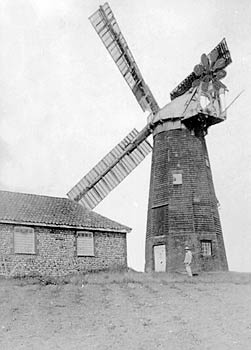
c.1890
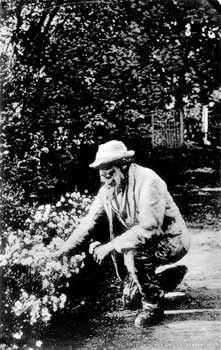
with Alfred Jermy standing
|
Sidestrand Jermy's smockmill |
|
|
c.1890
with Alfred Jermy standing
|
|
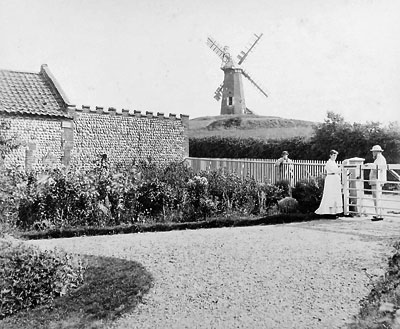
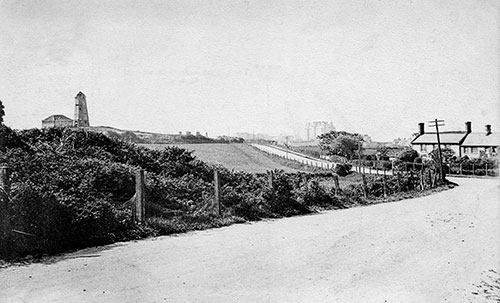
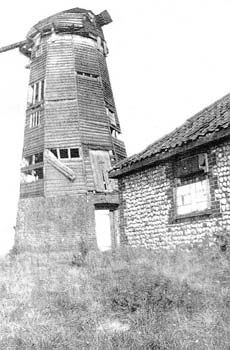
Jermy's smockmill at Sidestrand or Syderstrand, stood on the site earlier occupied by Sidestrand_smockmill that burnt down on 24th November 1836 and that mill was preceded by the even earlier Sidestrand_postmill. The mill site was actually in the parish of Northrepps. |
|
The 10 sided four storey wooden mill was set over a single storey brick base. The mill tower was tarred and the mill was sometimes known as the Black Mill. Four double shuttered sails powered 2 pairs of stones. One pair of sails had 8 bays of 3 shetters and the other pair had 6 bays of 3 shutters and 1 pair of 2 shutters. The norfolk boat shaped cap had a gallery and held an 8 bladed fan,each blade was painted red with blue and white bands. |
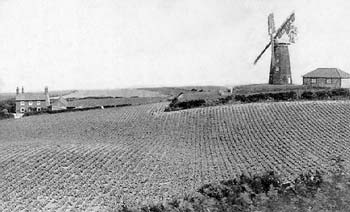 |
Mill and mill house to the left c.1900 |
|
The mill was shown on old historic sea charts as the Black Mill and used as a seamark to those at sea. |
To Millers To be Let and Entered upon Immediately |
Miscellaneous |
Windmill and Small Farm |
ELLIS NEWSTEAD, the surviving Trustee of the will of Mr. Philip Shickle deceased, to John Gurney Hoare Esq. Conveyance of the freehold and covenant to surrender the copyhold parts of an estate at Sidestrand and Northrepps in Norfolk and assignment of wind corn mill standing thereon. 8th December 1857. Large legal document on two sheets, on vellum, with seals and signatures, folded. In fine state of preservation. Ellis Newstead is known to have lived in Cromer from 1826 to 1860. He was listed in 1836 as a "lighthouse keeper", and in 1841 as a "ship owner". John Gurney Hoare (1810-1876), a member of the banking family with extensive property holdings in Norfolk, was the prime mover in the battle to save Hampstead Heath from development. Ellis Newstead received a total of £950 for the property. Ref. Indenture relating to sale of mill - 8th December 1857 |
|
It is unclear as to whether Henry Lee wished to move and erect a new mill elsewhere, replace the existing mill or raise an additional mill nearby. |
To Millers |
Situations Vacant |
Situations Vacant |
SIDESTRAND near Cromer |
 |
 |
|
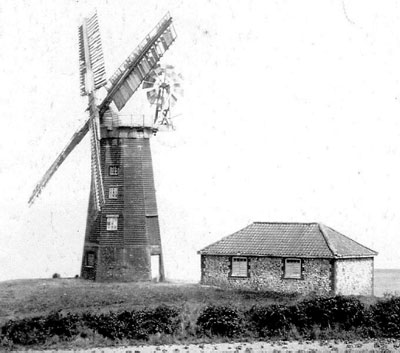
c.1905 |
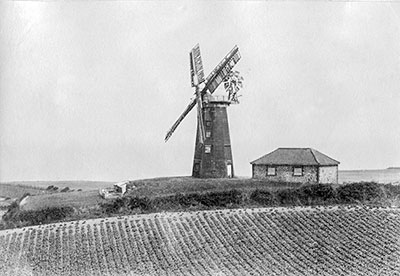
c.1906 |
 |
 |
|
Possibly Louie Jermy talking to passers by c.1905 |
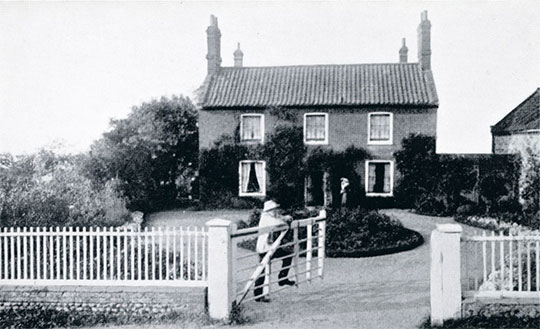
Courtesy of the Mills Archive Trust Alfred Jermy at the mill house c.1910 |
 |
|
c.1916 |
Tarred smockmill at Sidestrand blown down in gale Nov. 6th, 1921 |
The Maid of the Mill. Louie Jermy of Poppyland and her times, 1864 to 1934 |
 |
 |
|
Courtesy of the Mills Archive Trust
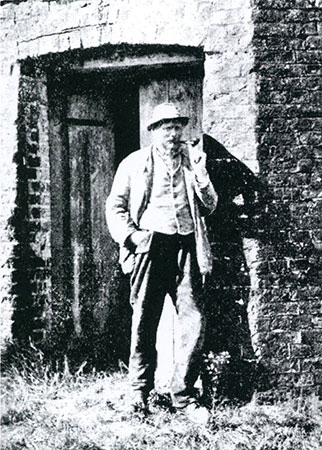
Alfred Jermy outside the mill c.1909 |
Alfred Jermy c.1915 |
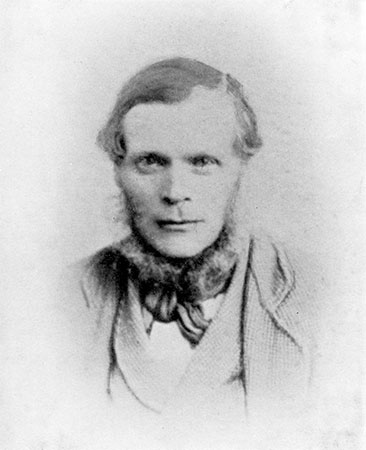
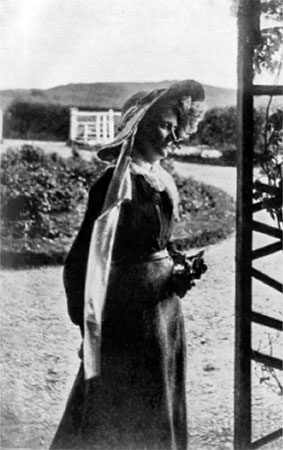
During the from the 1860's to 1916 the mill was in the hands of Alfred JERMY. His daughter Maria Louisa was born at the millhouse 1864 and in 1883 she met the journalist Clement Scott of the Daily Telegraph who had been dispatched to Cromer to write and article on the recently expanded rail line from Norwich. The drama critic of the Daily Telegraph and the Morning Post Clement Scott arrived in Norfolk in August 1883. Unable to find himself accommodation he was put up in the Miller's House in Sidestrand. He was so taken with the area that he wrote a number of articles in the newspapers expounding the virtues of Norfolk, which eventually resulted in Cromer and the surrounding area becoming a fashionable place for holidays for the rich and famous. He named his articles and, subsequent book Poppy-land. The book was dedicated to the Miller's daughter.. The millhouse itself became a magnet for other writers and bohemians who followed Scott in search of the tranquil experience he had described so poetically. Whilst for Louie - she was immortalised as"The Maid of the Mill". |
 |
 |
Courtesy of the Mills Archive Trust Alfred Jermy c.1880 |
Courtesy of the Mills Archive Trust Louie Jermy aged about nineteen - c.1883 |
My father knew Louie as he was born in 1909 and used to stay with her. I know when dad visited she had moved out and to quote dad ". . . was living a rather eccentric life." |
 |
|
c.1920
after Alfred Jermy had died
|
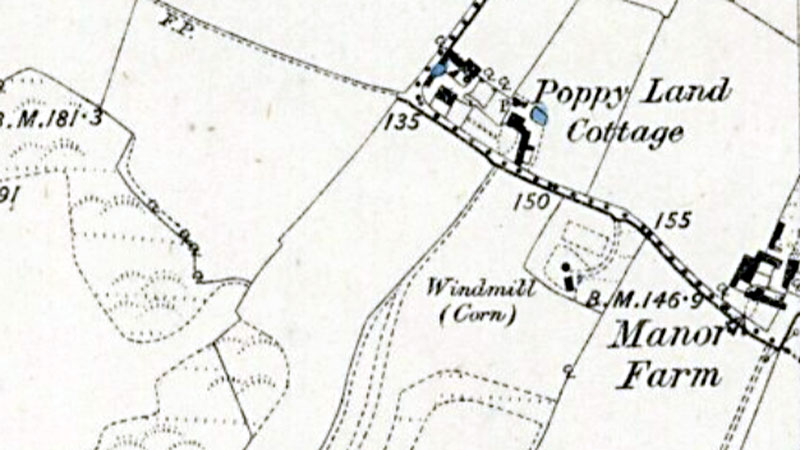 |
O. S. Map 1885 Courtesy of NLS map images |
|
Kelly's 1879: Mrs. Harriet Lee, farmer |
| October 1837: Newly built mill advertised to be let O.S. map 1838: Windmill White's 1845: John Lee, corn miller White's 1854: Henry Lee, corn miller 1857: Henry Lee, miller July 1857: Mill advertised for sale by auction 1859: Henry Lee, miller White's 1864: Henry Lee, corn miller & farmer 1868: Henry Lee, miller 1871: John Starling, miller & farmer September 1871: Mill advertised to be let 1872: John Starling, miller & farmer 1875: Alfred Jermy, miller Kelly's 1879: Alfred Jermy, miller
White's 1883: Alfred
Jermy, corn miller
1910: Miss Louie Jermy, tenant |
If you have any memories, anecdotes or photos please let us know and we may be able to use them to update the site. By all means telephone 07836 675369 or
|
| Nat Grid Ref TG25424020 |
Copyright © Jonathan Neville 2004 |