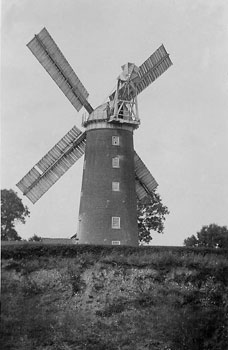
Mill working - c.1909
|
Carbrooke
Mill Lane towermill |
|
|
Mill working - c.1909
|
|
Carbrooke
tower mill stood in Mill Lane and was built for Richard Dewing J.P., D.L. of Carbrooke Hall in
1856, replacing an earlier postmill. The five storey mill had two pairs of double shuttered sails that did not match, the outer pair were from Little Cressingham and had 8 bays of 3 shutters and the inner pair had 10 pairs of 3 shutters, although the innermost bay was empty. The boat shaped cap had a petticoat and a gallery and supported a left handed 8 bladed fan. The ground floor and meal doors both faced west. |
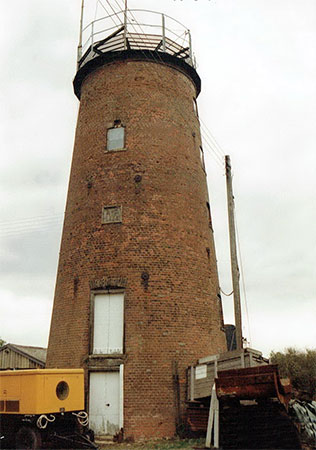
An date was inscribed in raised letter on a stone on the outside of the tower |
R D 1856 |
| A casting on the rear plate of the brakewheel read: W. H. WIGG & CO., EAST DEREHAM The company ceased trading in August 1880. |
|
The curb had a flange for the guide rollers to prevent the cap from lifting in high winds. |
The original ironwork was said to have been manufactured in Belgium to a metric measurement system. |
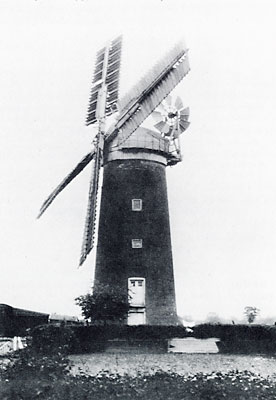 |
Mill working - c.1909 |
CAP W.H. Wigg & Co. East Dereham Which dates it to 1879/80. Keyed on to long flanges on windshaft. Iron upright shaft 12 tread ladder STONE FLOOR Wall narrower than meal floor wall. 3 pairs of underdriven stones. Mixed French burr and composition. Octagonal vats with hoppers, horses, shoes and damsels. Stones - N.W. 4 ft. 6 ins. S.W. 4 ft. S.E. 3 ft. 6 ins. (French burr bedstone only in situ.) 3 ft. 6 ins. composition stone freestanding against wall. Wooden ‘A’ frame for levelling bedstones by plumb line. Iron crane for lifting stones made locally. 2 mill thrifts on wall below east window (2 of 3) Oat crusher, later engine driven 11 tread ladder. One French burr runner stone – Garner, mark Lane, London. MEAL FLOOR Floor 16 ft. 3 ins. diameter. 12 ft. to ceiling. 2 leaf door to west with platform on chains. Windows east and south. Iron mortice great spur wheel on iron upright shaft. Supported by iron pillar and frame. 8 ft. 6 ins. diameter. 8 armed. All one piece but two repairs ?. Cogs, 8 x 17 = 136 +/- 3 iron bridge trees each with separate governors and tentering gear. Governors driven from respective stones spindles by belt and pulleys. All iron stone nuts of different sizes to match different sized stones:- N.W. 25 cogs, 6 armed S.W. 24 cogs, 6 armed S.E. 20 cogs, 4 armed Stone nuts on cones with rack and pinion gear for lifting up out of gear. Smaller all iron ring of cogs (8 x 16 = 128+/-) on underneath of great spur wheel drove shaft east with pulley. Drive by belt to bolter. 3 bell alarms with trail sticks striking arms of great spur wheel. Drive to stones from later outside engine came in on north side by shaft with bevel gear driving spindle with fourth pinion on great spur wheel. GROUND FLOOR Floor diameter 17 ft. Wall 2 ft. thick at base. 8 ft. to ceiling. 2 leaf door to west. Sack hoist immediately inside door. Central iron pillar with beam above cracked by lightning. 11 treat ladder. LADDERS Vertically above one another on south side. STEAM ENGINE Installed about 1885 drove one pair of stones in granary. PARAFFIN ENGINE Installed 1932 Crossley 13/17 h.p. (at slow and fast speeds) No. 1416 Manchester (1911?) Started by blow lamp and turning fly wheel Maximum revs. 250 p.m. Used to drive generator for searchlights in 1914/18 War. Later at Hall Farm, Carbrooke. Used at mill 1932/43 for grist work only. PRESENT STATE (1979) Cap frame with windshaft, but no cap, stocks, sails, fantail or brake wheel. Machinery from wallower and sack hoist to stones with vats. Also noted:- 2 wooden proof staffs 2 wooden thrifts Several mill bills Sack scales and weights Crossley engine back in its shed to within a foot or so of its original position. Harry Apling |
Situations Vacant |
Situations Vacant |
To be Let with possession at Michaelmas next. The MILL & 34 ACRES of LAND now in the occupation of Mr. S. Goddard. |
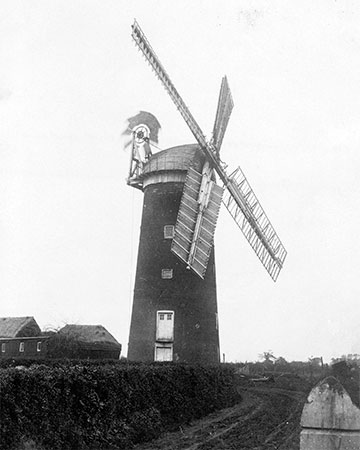 |
Mill working - c.1927 |
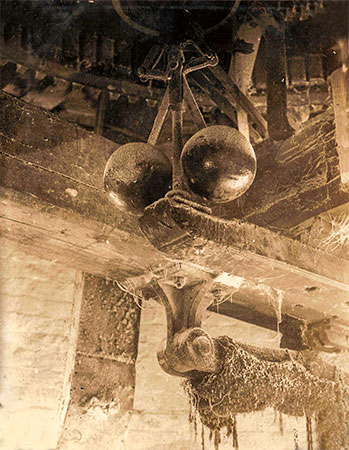 |
Governor - c.1927 |
Carbrooke, West Norfolk 1 mile from Watton station … Valuable Freehold (part Copyhold) Properties forming the Carbrooke Hall Estate Lot 6. Mill, residence etc. Carbrooke, 5a. 3r. 2p. Hampton & Sons Will sell the above by Auction at the Mart, London, E.C., on Monday July 30 at 2 o’c precisely (unless previously sold by private treaty) in 21 Lots. Particulars of … Messrs. Grigson & Robinson, Solicitors, Watton & of the Auctioneers, Hampton & Sons Ltd. 1 Cockspur St. London, S.W. Lynn Advertiser - 22nd June to 20th July 1900 |
West Norfolk One mile from Watton Station & Market Town on the Bury, Thetford & Lynn Branch of the G.E. Railway, 18 Miles from Norwich The Valuable Freehold (part Copyhold) PROPERTIES forming the CARBROOKE HALL ESTATE, situate in the parishes of Carbrooke, Watton, Scoulton & Griston … Lot 6. Mill, Residence etc. Carbrooke. 5a.3r.2p. Hampton & Sons will sell the above by Auction at the Mart, London, E.C. on Monday July 30 at 2 o’c precisely (unless previously sold by private treaty) in 21 Lots. Particulars of the Vendor’s Solicitor, Maurice Dewing, Esq. Horsham, of Messrs. Grigson & Robinson, Solrs. Watton & of the Auctioneers, Hampton & Sons Ltd. Cockspur Street, London, S.W. Lynn Advertiser - 21st July 1900 |
PROPERTY MARKET |
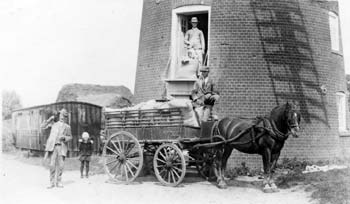 |
c.1910 |
Herbert Jeremiah Minns standing in the doorway of the mill. The sign on the cart reads |
TITLE From Conveyance 10 December 1900 and later Abstract Richard Dewing of Carbrooke Hall to Benjamin Chaston Richard Dewing to Alfred Chaston Copyhold parts for £500 1862 1869 1876 1876 1887 1899 1878 1900 1900 1921 1925 1925 1967 |
 |
 |
|
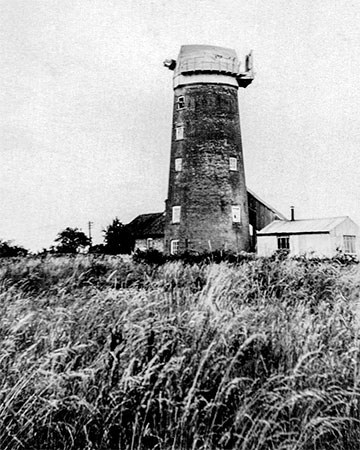
16th July 1939 |
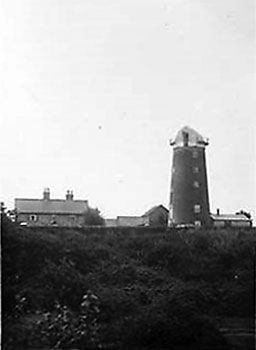
25th July 1939 |
 |
|
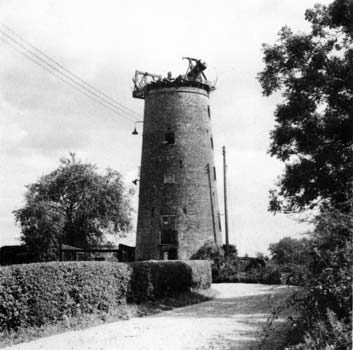
1st
September 1970
|
|
Samuel Goddard was miller between 1879-1890 and by 1888 was using a steam engine for a separate set of additional stones. He then moved on to Little Cressingham wind/watermill where he and his wife unfortunately died. |
 |
|
18th May 1980 |
In 1932 the sails were removed by Martins, the Beccles millwrights. Herbert Willie Minns continued with grist grinding using a Crossley 13/17 h.p. paraffin engine until 1943. |
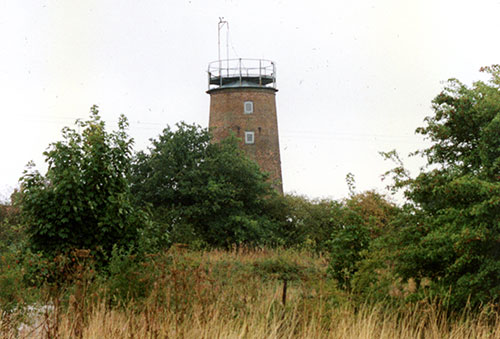
On 10th October 1979, millwright John Lawn removed the windshaft and the remains of the cap frame by crane. |
 |
 |
|
1989
|
1990 |
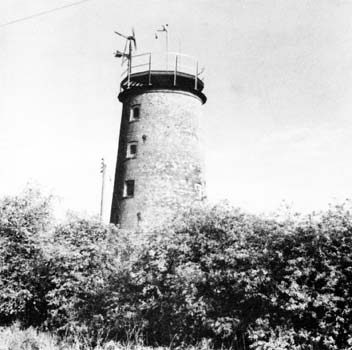
In 1980 a four bladed propeller driven dynamo and a wind gauge were fitted to the top of the tower with the intention of producing electricity that would charge batteries for lighting. However, the project proved unsuccessful. |
By 1985 the stone vats had been removed as the wood had rotted. Other wood work on the stone floor was renewed, the bells were replaced and the tentering gear was cleaned and greased. At this time it was envisaged that an electric motor might be used to drive the stones. |
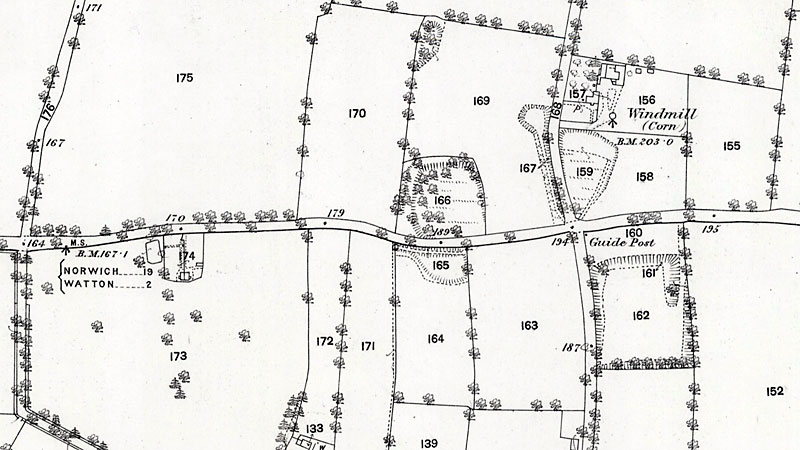 |
O. S. Map 1882 Courtesy of NLS map images |
1856: Mill built for Richard Dewing to replace earlier postmill on the same site
1939: Mill tower with cap, petticoat, fanstage, gallery and windshaft, working with auxiliary power |
If you have any memories, anecdotes or photos please let us know and we may be able to use them to update the site. By all means telephone 07836 675369 or
|
| Nat Grid Ref TF 95240096 |
Copyright © Jonathan Neville 2004 |