 |
|
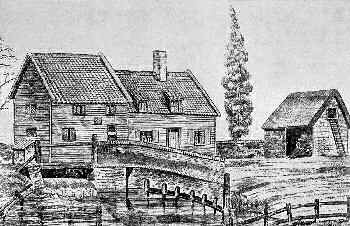
1793
|
|
Earsham Mill
River Waveney |
|
|
1793
|
|
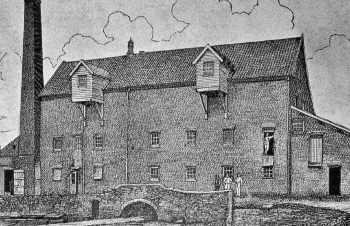
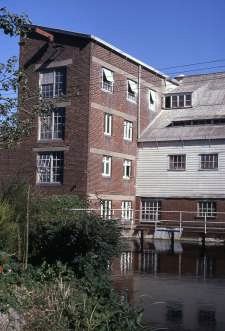
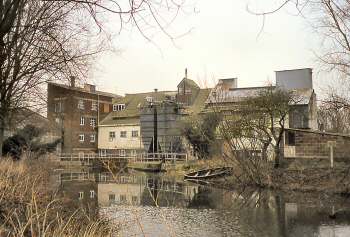
Earsham Mill dates from Saxon times and adjoins ancient earthworks. It was a brick built mill with a pantile roof. Along with Ditchingham and Ellingham, it was one of the only three Norfolk watermills on the Waveney. The mill was rebuilt by R. H. Clarke on the existing site in 1862. It was fitted with 12 pairs of stones powered by a waterwheel and a steam engine. A roller plant manufactured by Whitman & Binyon was installed in 1893. At this time, flour from Earsham was being sent to Newcastle by water transport. |
|
From the time it was granted to the Norfolk family, along with the half hundred, from the crown, it paffed with Forncet manor, the duke of Norfolk being lord of the manor and hundred, and owner of the park here, which is now difparked, though in the 35th of Edward I it was well ftocked, and belonged to the lodge, or manor-houfe, which had 286 acres in demefne, fixteen acres of meadow, and the halls dykes, or fifthery, a water-mill, and many woods and fens; all of which were kept for the ufe of the family of Roger Bigot, then lord, who chiefly refided at his adjacent caftle of Bungay, in Suffolk. |
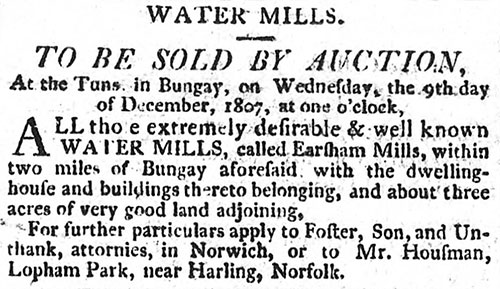 |
Norfolk Chronicle - 28th November 1807 |
 |
|
Thomas Clarke, miller in 1793
|
 |
|
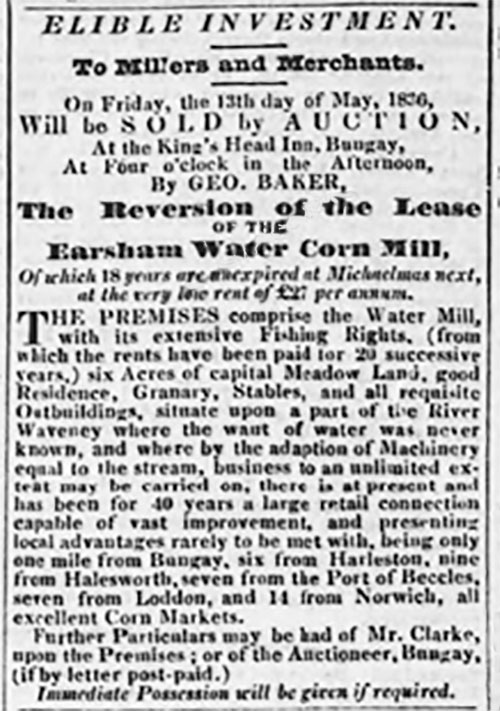
Norfolk Chronicle - 23rd April 1836
|
 |
|
Earsham roller mills in 1893 |
 |
|
Thomas Clarke, miller in 1893
|
c.1824 Thomas Clarke made a will in which he made mention of his wife Ann and also stated that a further 30 years of his 60 year lease from the Duke of Norfolk was still yet to run. This means the lease was granted c.1784 and was possibly taken out by Thomas' father, Wiliam Clarke. Thomas Clarke died in 1834. |
|
It
would appear that sometime between 1845 and 1860 Richard and Charlotte
Narburgh left for the USA, without their children. A Richard and Charlotte
Narburgh show up in the Illinois census of 1860 and as their ages tie
in it seems probable that it was the same couple. However, they presumably
returned to England as they do not appear in any later surveys. |
|
To be let by Tender |
|
Thomas Jeckyll , Architect and Designer, 1827-81 |
Jeckyll built a water mill and connecting cottage at Earsham for the
Duke of Norfolk ....1862 ..... The contractors James Maxim Smith and Lewis
Bull won the tender for this commission on an estimate of £1,069 with
an additional £454.1.5 for the necessary machinery. The three-story
mill composed of brick and cement had a small, attached four-bedroom house.
The mill still stands today but in a poor condition, and the cottage has
been demolished. Susan Weber Soros & Catherine Arbuthnott - Yale University Press 2003 |
 |
|
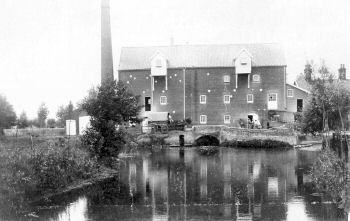
c.1900
|
|
The steam engine house is to the left of the mill on the above photo but there is also an auxiliary drive belt attached to a pulley on the right hand side of the mill and is obviously being powered by some sort of engine hidden from view. |
 |
|
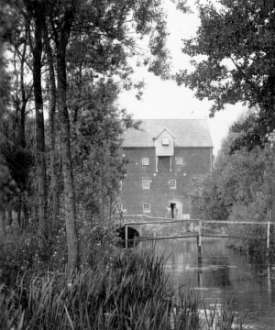
c.1915
|
James Thurston was miller in the mid 1850s. He was born c.1802-05 in South Elmham and married Sarah Fairhead. They had some 15 children, one of whom was possibly George Thurston who was a miller's apprentice in 1841 living in South Elmham, before moving to Mundham by 1861. |
 |
|
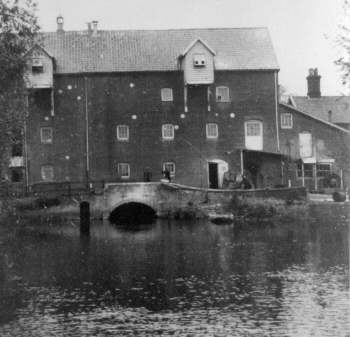
1918
|
 |
|
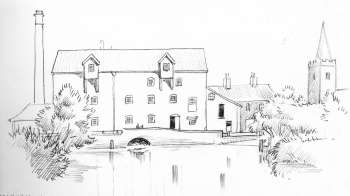
Pippa Miller's copy of an old photograph 1923
|
 |
c.1923 |
|
Situations Vacant |
|
Earsham Mills,
Bungay, Mar 9/65. Mr. Smithdale, Sir, Pray what is your price for a good substantial ten horse power horizontal engine with heating apparatus & a 12 horse boiler, price on rail or into craft at Norwich. Yours Respectfully, R. H. Clarke. |
| King Street, Norwich, March 10th 1865. Mr. R. H. Clarke, Dear Sir, In reply to yours of the 9th to hand this morning I beg to say that I can supply you with a First Class 10 Horse Horizontal Steam Engine made from the same patterns as the one I fixed at Wainford Mills with 12 Horse Cornish Boiler 14ft long, 4ft. 6in. dia with Heating Apprts and all fixings complete, put to work exclusive of Brickwork for the sum of Two Hundred and thirty five pounds. Awaiting your reply, I remain, Dear Sir, Yours respy, £245. 0. 0. pro T. S., T. S. jr. P.S. If you would name any day next week I would take the liberty of driving over to see you in reference to the above. |
|
Following
his inspection of Earsham mill, Thomas
Smithdale sent in his tender for the work required to work the mill
by steam power as well as water:
|
St. Ann's Iron Works, King Street, Norwich, April 4th 1865. To Mr. Clarke, Sir, The following is a list of articles required for driving 4 pairs of Stones in your Mills by Steam Power, Viz 18 feet of 3¼ inch thick Wrought Iron Bright Shafting (or thereabouts), 4 Wrought Iron Crotch Spindles, turned & fitted with Damsels attached. 4 New Maces. 4 2½ In. Plumb blocks fitted with Brasses & Bolts. 3 3¼ in. do. do. do. 3 Cast Iron Brackets for carrying Counter Shaft. 6 Bolts & 6 Wall Plates for Do. 1 4ft. Drum, turned & Bored. 4 3ft. 4in. Do. Do. Do. 4 2ft. 6in Do. Do. Do. 2 Cast Iron Brays for carrying Top End of crotch Spindles. 8 Bolts, Nuts & Plates for Do. with Men's Time fitting and fixing the same in your Mill for the sum of Seventy Two pounds, ten shillings and sixpence. £72.10. 6. The Whole of the above shall be made of the best materials & sound workmanship and put to work. Awaiting your reply, I remain, Dr. Sir, Yours Respy, Thos Smithdale. |
|
Situations Vacant |
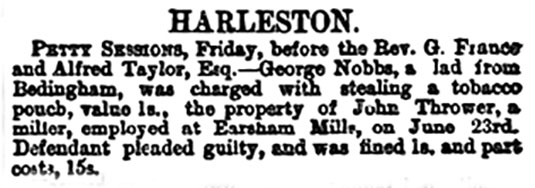 |
|
Eastern Daily Press - 14th July 1890 |
|
Charles Marston
purchased the mill in 1900. |
|
The Miller Challenge Cup 1923 |
| British Wheat
Flour Class A 1st Prize - Charles Marston of Bungay Class C 1st Prize - Charles Marston of Bungay |
 |
 |
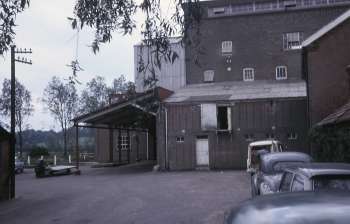
June 1967 |
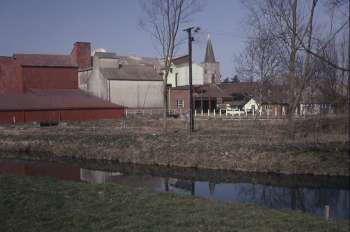
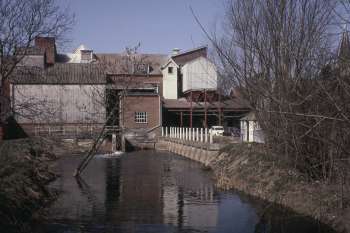
September 1968 |
 |
 |
|
April 1969
|
April
1969 |
 |
|
October 1969
|
|
NEW MILL PLANT GOES IN VIA ROOF |
Modernisation of the 200-year-old Earsham Mill for use as a feed mill meant that to get heavy equipment into the the building yesterday part of the roof had to be removed. A 100 ft. crane was used to lift pressing, feeding, cooling and sifting plants into the mill and today the 8 ft. square hole in the roof will be re-covered with asbestos sheeting. The mill is owned by Brooks Savill Ltd., agricultural merchants, and the company are also building a 5000 sq. ft. warehouse alongside the mill. The mill, which was converted from flour to feed in 1962, is 45 ft. high and is used to make cattle, pig and poultry feeds. The heaviest machine lifted yesterday was a two-ton gearbox to drive the pressing plant and to accommodate all the machinery, holes were cut in the three top floorsof the four-storey building. Eastern Daily Press - 14th November 1974 |
 |
|
Eastern Daily Press - 24th July 1975 |
 |
|
Norwich Mercury - 10th September 1982 |
 |
|
RHM plaque 5th January 1984
|
 |
|
Mill dam 5th January 1984
|
 |
|
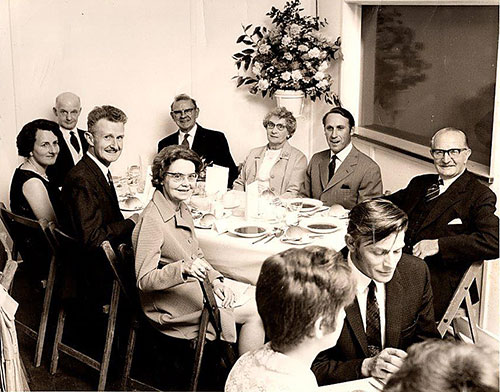
Mill Foreman Don Tilney's retirement meal - Saturday 26th July 1971 |
 |
|
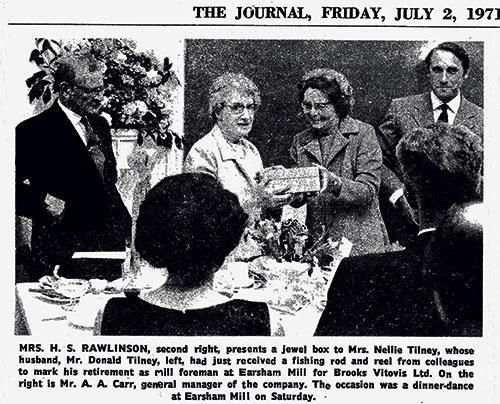
Mill Foreman Don Tilney's retirement - presentation to his wife Nellie |
 |
|
Mill Foreman Don Tilney's retirement - newspaper report |
Could you redevelop this £250,000 historic mill? |
A former water mill dating to Saxon times is to go under the hammer for a guide of £250,000 in need of redevelopment. Earsham Mill, which was rebuilt in 1902 but which had a £250,000 refit in 1975, offers 36,500 square feet of industrial and retail space with development or investment potential. It is up for auction on Wednesday. Ancillary buildings were also built on the site and in 1962 it changed from being a flour mill to creating animal feed and most recently it traded as a builders merchant. Robert Hurst, auction manager at Auction House, said: "The premises are now vacant and in need of updating and general repair. Potential exists for a wide range of other uses (subject to planning), which may include light industrial, leisure, residential or mixed use." The site, which has a long road frontage, extends to four acres and includes areas of hard standing, parking and river frontage along with the former mill building, a traditional brick built barn and a workshop. The main building has accommodation over four levels and comprises a former ground floor retail area with offices. Further offices and storage space is available on the upper floors. The mill has a long history which saw it trebling its capacity to 1000 tons a week in 1975 following its investment and in 1982 it was put up for sale for offers in excess of £100,000. The Auction House sale takes place on Wednesday at Dunston Hall Hotel in Norwich at 11am. Eastern Daily Press - 8th April 2019 |
Why this man bought a derelict Norfolk mill at auction for £380,000 |
The business owner who bought a dilapidated old mill for £130,000 over the £250,000 guide price said: "I've never bid at an auction before.'
Iain Gwynn, who runs Draganfly Motorcycles in Bungay, selling parts for vintage motorbikes, went along to the auction in Norwich last month - and came away as the owner of Earsham Mill. He'd gone along to the sale with his parents with the intention of buying the property, for sale for a guide price of £250,000 but got involved in a bidding war which saw the hammer come down £130,000 later. "The auction was incredible, I felt like a 12-year-old boy, my dad said; 'don't be the first person to start bidding.' Half way through the bididng, he said to me, 'now start' but I'd already started. My heart was pounding and my legs were like jelly and after I bought it, people were coming up to me to say congratulations." Iain, 36, has big plans for the large property which offers 36,500 sqft of industrial and retail space. He's initially going to offer up some of the more modern warehouse space which is intact for businesses to use as storage while doing up the main Victorian building with the view to relocate his motorbike business there. Such is the state of the former mill, which was rebuilt in 1902, that he thinks it's going to take him at least a year to 18 months to get it ship-shape. "Already a children's fitness charity has come and looked at some of the space and is interested in running a boxing club. The work needed ranges from some areas which just need a coat of paint to others where you can look up and see through to the sky." |
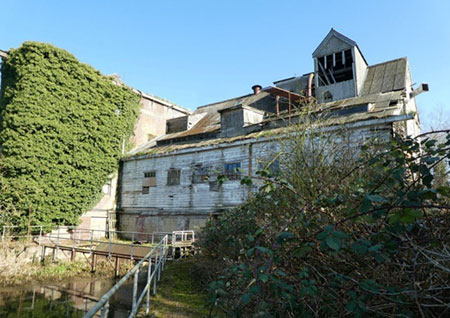 Auction house photo |
He reckons there are around 20 business units available and isn't fazed on the project. In fact the family own Blows Self Storage, situated behind Draganfly, so have knowledge in this business. "My sister Lauren and I grew up in a converted barn, my parents renovated a farm in the 1970s and our business is in an old maltings so we know about working with old buildings." Iain recently took over the motorbike business, started by his dad Roger Gwynn, 65, in 1976 in London, which relocated to Bungay in 1984. But he's now got Roger out of retirement hoping to get some help on the relocation project. "Draganfly is in the middle of Bungay and there just isn't any space to expand. We've grown the business over the years and vintage motorbikes are hugely in demand, they're very in vogue and we supply all the spare parts for them." Earsham Mill has a long history which saw it trebling its capacity to 1000 tons a week in 1975 following its investment and in 1982 it was put up for sale for offers in excess of £100,000. Ancillary buildings were also built on the site and in 1962 it changed from being a flour mill to creating animal feed and most recently it traded as a builders merchant. The Auction House sale took place at Dunston Hall Hotel last month. Eastern Daily Press - 29th May 2019 |
|
On seeing that Earsham Mill had recently been sold, my Mum googled Earsham Mill and came across your web page. My father is Frank Cannell, who became mill manager in 1975 and both him and my Mum are on the photo of Don Tilney's retirement dinner. My Mum is the lady in the dark sleeveless dress, with my Dad sitting to her right. |
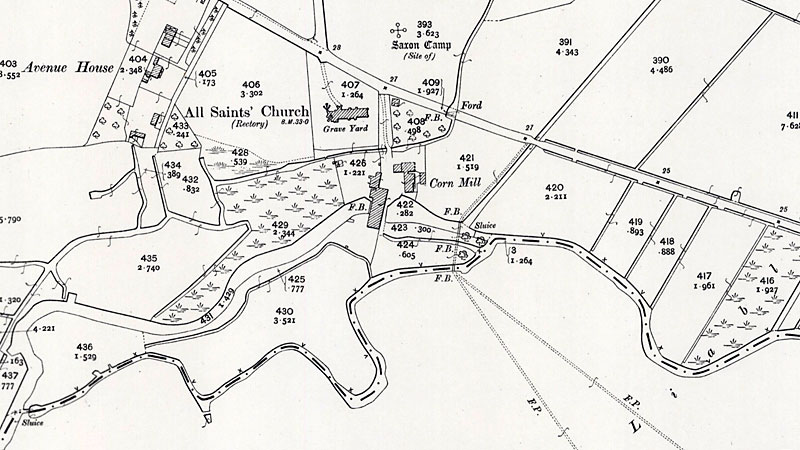 |
O. S. Map 1903 |
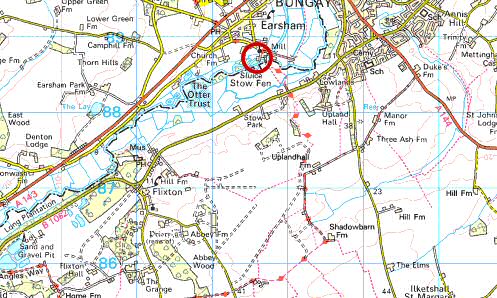 |
O.S. Map 2005 Image reproduced under licence from Ordnance Survey |
| Domesday Book 1085: Watermill 1307: Watermill kept for the use of the family of Robert Bigot of Bungay Castle
1502: Mill conveyed to Alan Catys and wife, Henry Colman, John Goodewyn and John Mansheppe 1793: Thomas Clarke, son of Hoxne miller William
Clarke, took over at the age of 24
White's 1845: Richard Narburgh jnr, corn miller
White's 1864: Robert Harvey Clarke |
If you have any memories, anecdotes or photos please let us know and we may be able to use them to update the site. By all means telephone 07836 675369 or
|
| Nat Grid Ref TM 32638872 | Copyright © Jonathan Neville 2004 |